
By: Christine Olsen, Registrar
As I have discussed in detail in my blog “Making an Exhibition Happen”, each loan has specific requirements from the lenders which must be followed; for example, just as upon unpacking and installation, there are three lenders to this show that require a courier to oversee de-installation and packing. This means making flight and hotel reservations for each courier, and scheduling de-installation and shipping to coincide perfectly with their visits. It is a difficult juggling act, and it has taken me weeks to work out the details. Finally, two lenders to this exhibit require that their courier also ride on the truck for the return of their artwork; one lender will ride all the way from Cooperstown to Detroit in one day!
All of the crates for the work in this exhibit have been stored since April in a storage space with security, pest and environmental controls (you can go back and see the pictures I posted of crates stacked in the hallway in my previous blog). When it is time for de-installation, the crates will be moved into the exhibition gallery to be packed by myself and other Curatorial staff. The artwork itself is thoroughly examined again by me for condition changes and has detailed pictures taken of its packing. As anyone who has read my blogs knows, condition reporting itself takes a lot of time, and I can only do it when the museum is closed to the public.
 This is the life of every loan that comes in and out of the museum; after doing this for so long I have a system down so that this process goes smoothly. But of course there are glitches along the way and unexpected things that come up that I and my colleagues must contend with. It certainly makes the winter go by quickly! I will soon be blogging about loans that will be coming in for our Spring exhibitions, such as John Singer Sargent: Portraits in Praise of Women…if the technical aspects of registrarial work interest you, stay tuned!
As you may have read in my blog post “Making an Exhibition Happen” a lot of steps are involved in putting up and taking down an exhibit. In our exhibit, America’s Rome: Artists in the Eternal City, we had 134 works from 24 lenders, including Museum of Fine Arts Houston, Toledo Museum of Art and Brooklyn Museum of Art. In addition to some of the other projects that I am working on which I have blogged about, such as the Through the Eyes of Others Travelling show which returns from NYSM in January and preparing for the Thaw Travelling show to go to Cleveland in February, I am currently working on returning the loans for America’s Rome to their lenders since the exhibit closed on December 31st.  Instead of shipping with UPS, Fed Ex or a standard moving company, I work with a handful of exclusive fine art handling companies who specialize in shipping for high value and fragile cargo. Their trucks have special air ride suspension, temperature/humidity control and dual drivers with a security system; a few more options than the standard shipper would provide! Sometimes, lenders require an exclusive use shipment, which means that their loan is the only one on the truck. For those that do not require exclusive use, I often combine shipments for lenders that are geographically near one another; they call these direct shuttles, and many lenders like to know that their artwork is on board with loans from other museums who lent to the same exhibition.
Instead of shipping with UPS, Fed Ex or a standard moving company, I work with a handful of exclusive fine art handling companies who specialize in shipping for high value and fragile cargo. Their trucks have special air ride suspension, temperature/humidity control and dual drivers with a security system; a few more options than the standard shipper would provide! Sometimes, lenders require an exclusive use shipment, which means that their loan is the only one on the truck. For those that do not require exclusive use, I often combine shipments for lenders that are geographically near one another; they call these direct shuttles, and many lenders like to know that their artwork is on board with loans from other museums who lent to the same exhibition. As I have discussed in detail in my blog “Making an Exhibition Happen”, each loan has specific requirements from the lenders which must be followed; for example, just as upon unpacking and installation, there are three lenders to this show that require a courier to oversee de-installation and packing. This means making flight and hotel reservations for each courier, and scheduling de-installation and shipping to coincide perfectly with their visits. It is a difficult juggling act, and it has taken me weeks to work out the details. Finally, two lenders to this exhibit require that their courier also ride on the truck for the return of their artwork; one lender will ride all the way from Cooperstown to Detroit in one day!
All of the crates for the work in this exhibit have been stored since April in a storage space with security, pest and environmental controls (you can go back and see the pictures I posted of crates stacked in the hallway in my previous blog). When it is time for de-installation, the crates will be moved into the exhibition gallery to be packed by myself and other Curatorial staff. The artwork itself is thoroughly examined again by me for condition changes and has detailed pictures taken of its packing. As anyone who has read my blogs knows, condition reporting itself takes a lot of time, and I can only do it when the museum is closed to the public.
This is the life of every loan that comes in and out of the museum; after doing this for so long I have a system down so that this process goes smoothly. But of course there are glitches along the way and unexpected things that come up that I and my colleagues must contend with. It certainly makes the winter go by quickly! I will soon be blogging about loans that will be coming in for our Spring exhibitions, such as John Singer Sargent: Portraits in Praise of Women…if the technical aspects of registrarial work interest you, stay tuned!


 While we are all looking forward to re-opening in April with a bevy of new exhibitions (cant wait for
  As my colleague Christine Olsen noted in her blog
  By crating standards it really isn’t that large, but this is the largest crate that has come into Fenimore Art Museum during my time here as Registrar. Despite receiving measurements from the crate fabricator and checking the maximum door height of our loading dock prior to shipment, upon delivery I discovered that the crate simply wasn’t going to make it through our loading dock doors and down the winding halls to the Great Hall Gallery.
  Needless to say this will all have to be done in reverse in January when it is time for the loan to go back to Spanierman Gallery. By then there will be snow to contend with on the back lawn of the museum…but that is another blog.
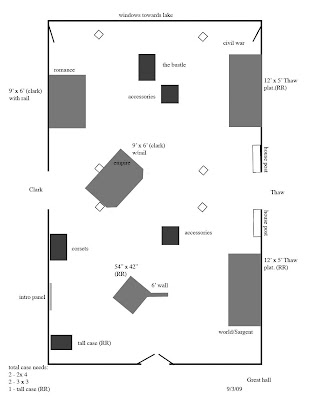 You can imagine our delight when we found the beauty of designing in a graphics program. Yes, you still had to make a floor plan and size stuff, but no one could knock the darn thing off the table and scatter little pieces of paper to the wind. You could even create multiple versions of a layout and email them to your colleagues! Ya-hoo, we were talking progress.
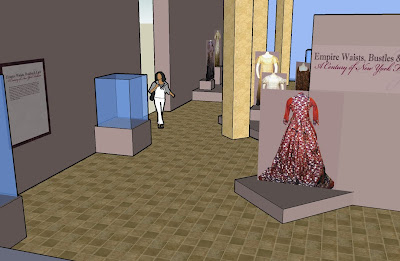 At this point many of you are nodding your heads and saying oh yes its Sketch-up (from Google). You would be right. For someone who started out way back using little cutouts to do floor plans this is indeed and amazing program. It is fairly intuitive to use. I find myself gaining skill as I go along. It does not do every single thing I would like it to, but it is a wonderful tool for giving you a fairly accurate feeling for how a gallery will look upon completion.
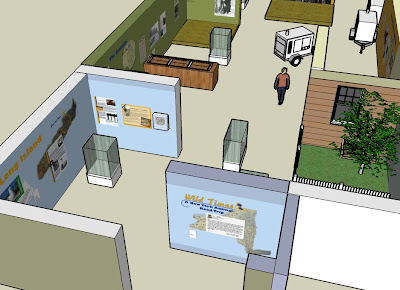 My next trick will be to learn how to interface google earth and sketch-up. The possibilities seem endless and as the technology evolves there will always be another exciting opportunity to do it better.
 Exhibitions may have a just few lenders or they have many, with lenders as close as the next town over or as far away as across country. For example, the current exhibition
  Let’s follow the path of a typical incoming exhibition loan at FAM: As soon as a shipping crate comes off the fine art shippers’ truck at our loading dock, it comes to the registrar’s office for safe keeping and to acclimate to the environment of the museum. All crates and the artwork they contain must continuously be in temperature and humidity controlled environments, and because of very slight changes during transport, it usually takes 24 hours for a safe transition from the environment of the truck to that of the museum. The crate is then moved to the exhibition gallery in which it will be unpacked. The empty crate is later stored in a holding area by the registrar’s office that has security, pest and environmental controls. During a busy exhibition season this holding area is lined to the ceiling with stacked crates and boxes! The artwork itself is thoroughly examined by the registrar for condition changes and has detailed pictures taken; each piece of artwork is given a temporary number and is entered along with all of its descriptive information into the museum’s collection database. Finally, the artwork is installed on the gallery wall along with a descriptive label. Of course, the entire process is done in reverse when it is time for the loan to go back to the lending institution.
 The next time you visit an exhibition at FAM, keep in mind how much time and effort went into getting each and every piece of artwork here. It really is an amazing process. We certainly feel that it is well worth it…we hope that you agree!
 Technology is still hot stuff. In fact now I do all my design work on a machine that often seems to know more than I do. America’s Rome: Artists in the Eternal City, 1800-1900, our feature exhibit at Fenimore this year, was laid out on a computer; graphics and design elements all composed on the same Mac G5. Now I am working on a map of the Roman Campagna and am impressed at how the Mac and Photoshop seem to be holding out on me – holding back on some secrets that will make this the map that will unlock the glories of the Roman Campagna to our visitors and link the paintings to those romantic names – Tivoli, Frascati, Nettuno, to name a few. The green and yellow ochre fields, Roman ruins, peasants, and waterfalls that the 19th-century painters found so intriguing. How to connect the names and images in a way that will make them easily accessible to the visitor is always the big design challenge. Sometimes the tools are more sophisticated than their driver and we all have to play a little catch-up.
 In the end, the results will exceed what was created with the slide rule, or the DeSoto, or the GE. The new technology can lead to amazing ends. Who knows where it may take the map and I.
 Twelve years ago I moved from Maine to a small town just outside of Cooperstown. I was embraced by the local community and within a short period of time, came to feel like part of a larger, county-wide community. This was a completely new experience for me because Mainers rarely identify themselves by the county they live in. But here in upstate New York, I soon realized the importance (and pleasure!) of county affiliations.
  Thank you Otsego County!
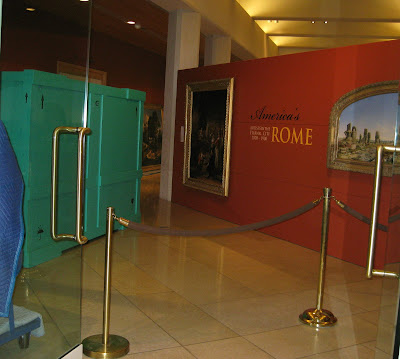 What a month it's been in Curatorial! After nearly two years of planning, more than 100 paintings have arrived on our doorstep to be uncrated and installed in time for Saturday's opening of America's Rome: Artists in the Eternal City, 1800-1900. The pieces look spectacular, especially when placed in their appropriate groupings and hung on the wall. The exhibition will take you through the Roman Forum, the Colosseum, and particularly the Campagna, or countryside. There are great Hudson River School style paintings by Thomas Cole, Albert Bierstadt, George Inness, Jasper Cropsey, and Sanford R. Gifford, among others. All of these painters traveled to Rome to improve their art, and the results showed in the fame they received upon returning and painting American landscapes in the same style. Come see for your self. The public opening is this Saturday, May 23, beginning at 10 am.

 I spend a lot of time planning exhibitions; deciding which artworks tell a particular story, negotiating to bring those works together here at the museum, writing or editing labels, and working with the exhibitions staff to create a layout that brings the visitor into the world that the art portrays. My absolute favorite part of this job, however, is sharing that world with visitors after the exhibition is mounted. Over the course of the season I might give dozens of tours and lectures to hundreds of people. When we have exhibitions that are particularly popular, we simply schedule more and I make the time.


