By Chris Rossi, Associate Curator of Exhibitions
As someone who shares her home with three cats I am always on the look out for felines in art. Truth-be-told I have an unofficial competition going in terms of representation of dogs versus cats in the Fenimore Art Museum collection. So, when I was back in our newly renovated painting storage area I was delighted to find another cat friendly portrait - Four Children and a Cat. In this 1840s portrait the cat is batting one of the children’s locket - familiar behavior to anyone who owns a cat.
How many other cats were prowling around the galleries and collection spaces I wondered? A quick survey found at least 8 cats (big and small) featured in portraits, paintings, toys, prints, quilts and statues. No surprise as some of those pieces came from the Gunn family, whose collection is now part of our own.
Although Mrs. Gunn had a reputation for not being overly fond of children she was plainly an animal lover. The following was recorded before her death in 1957:
“Most of all I like dogs, but now I keep cats. I, of course, will soon go. Dogs would grieve for me, but cats will not cry, will live out their time.”
The interviewer relates that “Neighbors thinking that Mrs. G worshipped cats were bringing or stealthily abandoning kittens at her door…Finally the stray cats found their way to the house on their own.” I would add that they found their way into the artwork as well.
Showing posts with label Chris Rossi. Show all posts
Thursday, December 29, 2011
Tuesday, December 13, 2011
Ring in the New
By Chris Rossi, Associate Curator of Exhibitions
As the old year winds down we here in the curatorial department are deep into preparations for the New Year. The Fenimore Art Museum closes its doors to the public on January 1 and that is when we do our big 2012 makeover in preparation of our April 1 re-opening. The 2011 temporary exhibits come down and artworks are returned to various lenders or to our storage areas.
The paint colors and graphics for next year’s exhibits are being planned now. Fonts are chosen to fit the theme or sense of the exhibits with something exotic for Heavenly Aida: Highlights from the Metropolitan Opera, sensual for Spellbound: The Metropolitan Opera's Armide, and spring-like for American Impressionism: Paintings of Light and Life. Floor plans are devised on computer using sketch-up, InDesign or good old paper and pencil. We need to know where the objects are going and what they will be displayed on before we move them out of storage or ship them from another museum.
It is an exciting time of anticipation. Choosing colors and designing the look of a show is a challenge but is also good fun. Our curatorial team spars over what they think is wonderful or horrible. One person’s dream color or font can be another’s nightmare! In the end we come up with a look that we believe enhances the objects on display without dominating them. It’s a vision that we enjoy and hope our visitors will as well.
As the old year winds down we here in the curatorial department are deep into preparations for the New Year. The Fenimore Art Museum closes its doors to the public on January 1 and that is when we do our big 2012 makeover in preparation of our April 1 re-opening. The 2011 temporary exhibits come down and artworks are returned to various lenders or to our storage areas.
The paint colors and graphics for next year’s exhibits are being planned now. Fonts are chosen to fit the theme or sense of the exhibits with something exotic for Heavenly Aida: Highlights from the Metropolitan Opera, sensual for Spellbound: The Metropolitan Opera's Armide, and spring-like for American Impressionism: Paintings of Light and Life. Floor plans are devised on computer using sketch-up, InDesign or good old paper and pencil. We need to know where the objects are going and what they will be displayed on before we move them out of storage or ship them from another museum.
It is an exciting time of anticipation. Choosing colors and designing the look of a show is a challenge but is also good fun. Our curatorial team spars over what they think is wonderful or horrible. One person’s dream color or font can be another’s nightmare! In the end we come up with a look that we believe enhances the objects on display without dominating them. It’s a vision that we enjoy and hope our visitors will as well.
Thursday, November 17, 2011
Final Destination - Indianapolis
By Chris Rossi, Associate Curator of Exhibitions
Greetings from the Indianapolis Museum of Art (IMA), where colleague Eva Fognell and I are installing our traveling exhibition, Art of the American Indians: The Thaw Collection, at its last venue in this 2-year long tour. The IMA has a collection of over 50,000 works of art from a variety of cultures and periods in art history. It also features traveling exhibits such as our own. Situated in the midst of 152 rolling acres, which include a nature park, mansion and gardens, the museum is a lovely place to install an exhibit.
Once again we are working with a topnotch crew to unpack our collection and get the objects in place. Every venue has given us a new way to think about the collection and how to present it. David, the designer here at IMA has chosen wonderful colors and layout for the gallery to offset and compliment the objects.
Greetings from the Indianapolis Museum of Art (IMA), where colleague Eva Fognell and I are installing our traveling exhibition, Art of the American Indians: The Thaw Collection, at its last venue in this 2-year long tour. The IMA has a collection of over 50,000 works of art from a variety of cultures and periods in art history. It also features traveling exhibits such as our own. Situated in the midst of 152 rolling acres, which include a nature park, mansion and gardens, the museum is a lovely place to install an exhibit.
Once again we are working with a topnotch crew to unpack our collection and get the objects in place. Every venue has given us a new way to think about the collection and how to present it. David, the designer here at IMA has chosen wonderful colors and layout for the gallery to offset and compliment the objects.
Thursday, October 27, 2011
That's SOME quilt!
By Chris Rossi, Associate Curator of Exhibitions
Quilt lovers have been flocking to our new Unfolding Stories: Culture and Tradition in American Quilts exhibition here at Fenimore. In addition to the raves about the expertise of the piecing, stitching or the creativity of our quilts many folks are dazzled by the sheer size of our “Star of Bethlehem” quilt. It was most likely created by either Providence or Henrietta Hildebrand Owens sometime around 1830. At a whopping 115” x 123” it is one big quilt.
As you can imagine, all of us –docents, visitors and staff– have spent some time trying to figure out why this terrific quilt is so darn big! Time to consult an expert! Jacquie Atkins, our guest curator, gave this response to my queries: “Quilts were functional objects in the 1820s, and although this may have been admired and used only for "best," it would not have been anywhere but on a bed…Keep in mind that many beds were higher in those days … so if the bed were five feet or so wide, that would have meant roughly a 2 1/2 foot drop on each side. Add a thick mattress (10-12" in well-off families) to an 18" high bed, and this does not seem so large after all.”
We can also say that in addition to its size, the quilt is a radiant example of the quilter’s skill and most likely created in a household that could afford the amount and expense of the fine fabrics.
Will the conversation and questions end there? We are wondering if this quilt was used to tuck multiple siblings into one bed on Christmas Eve. Time for a little more research…
Quilt lovers have been flocking to our new Unfolding Stories: Culture and Tradition in American Quilts exhibition here at Fenimore. In addition to the raves about the expertise of the piecing, stitching or the creativity of our quilts many folks are dazzled by the sheer size of our “Star of Bethlehem” quilt. It was most likely created by either Providence or Henrietta Hildebrand Owens sometime around 1830. At a whopping 115” x 123” it is one big quilt.
As you can imagine, all of us –docents, visitors and staff– have spent some time trying to figure out why this terrific quilt is so darn big! Time to consult an expert! Jacquie Atkins, our guest curator, gave this response to my queries: “Quilts were functional objects in the 1820s, and although this may have been admired and used only for "best," it would not have been anywhere but on a bed…Keep in mind that many beds were higher in those days … so if the bed were five feet or so wide, that would have meant roughly a 2 1/2 foot drop on each side. Add a thick mattress (10-12" in well-off families) to an 18" high bed, and this does not seem so large after all.”
We can also say that in addition to its size, the quilt is a radiant example of the quilter’s skill and most likely created in a household that could afford the amount and expense of the fine fabrics.
Will the conversation and questions end there? We are wondering if this quilt was used to tuck multiple siblings into one bed on Christmas Eve. Time for a little more research…
Thursday, October 6, 2011
Back Stage
By Chris Rossi, Associate Curator of Exhibitions
Or should I say, below the stage?
One of the things I love about my job is going where mere mortals usually don’t get to go. Let’s face it, we all like to have the restricted access door opened for us, or the velvet rope pulled aside for our entrance into some institution’s inner sanctum. Viewing a museum’s inner workings or collections is a real treat.
So you can imagine my enthusiasm when coworker Michelle Murdock and I got a behind the scenes peek at the Metropolitan Opera archives. The Fenimore Art Museum and the Glimmerglass Festival are enjoying creative collaborations, with our museum launching exhibits that are in tune (pardon the pun) with Glimmerglass’s repertoire. On that note, the Metropolitan Opera has kindly opened its considerable collections to us for possible display next year.
If you are an opera fan a visit to the Met Opera archives is a plunge into sensory overload. Walls are covered with images of famous singers and conductors while the storage area is neatly packed with costumes sporting the Met Opera label and familiar names such as Price, Ponselle and Domingo. Music from the dress rehearsals, going on overhead, is piped into the archives. Heady stuff, and a wonderful way for us to shape up an exhibit for next year!
Or should I say, below the stage?
One of the things I love about my job is going where mere mortals usually don’t get to go. Let’s face it, we all like to have the restricted access door opened for us, or the velvet rope pulled aside for our entrance into some institution’s inner sanctum. Viewing a museum’s inner workings or collections is a real treat.
So you can imagine my enthusiasm when coworker Michelle Murdock and I got a behind the scenes peek at the Metropolitan Opera archives. The Fenimore Art Museum and the Glimmerglass Festival are enjoying creative collaborations, with our museum launching exhibits that are in tune (pardon the pun) with Glimmerglass’s repertoire. On that note, the Metropolitan Opera has kindly opened its considerable collections to us for possible display next year.
If you are an opera fan a visit to the Met Opera archives is a plunge into sensory overload. Walls are covered with images of famous singers and conductors while the storage area is neatly packed with costumes sporting the Met Opera label and familiar names such as Price, Ponselle and Domingo. Music from the dress rehearsals, going on overhead, is piped into the archives. Heady stuff, and a wonderful way for us to shape up an exhibit for next year!
Tuesday, September 20, 2011
Tips from the road
By Chris Rossi, Associate Curator of Exhibitions
After packing and installing our traveling exhibition, Art of the American Indians: The Thaw Collection six times I've picked up a few things. Curator Eva Fognell and I like to think that by the time we finish the tour we may have perfected installing and packing the 111 American Indian objects we have been traveling.
At each venue we have had the pleasure of working with talented preparators who have taught us a few new tricks about art installation. The Cleveland Museum of Art staff tipped us off on new ways to coat and pad our brass mounts.
Minneapolis Museum of Art staff introduced us to the use of magnets for hanging textiles. That technique was just the thing for installing the unframed canvasses by Awenheeyoh Powless in the 8th Contemporary Iroquois Art Biennial: 4 Artists Under 30 exhibit now on display at the Fenimore Art Museum:
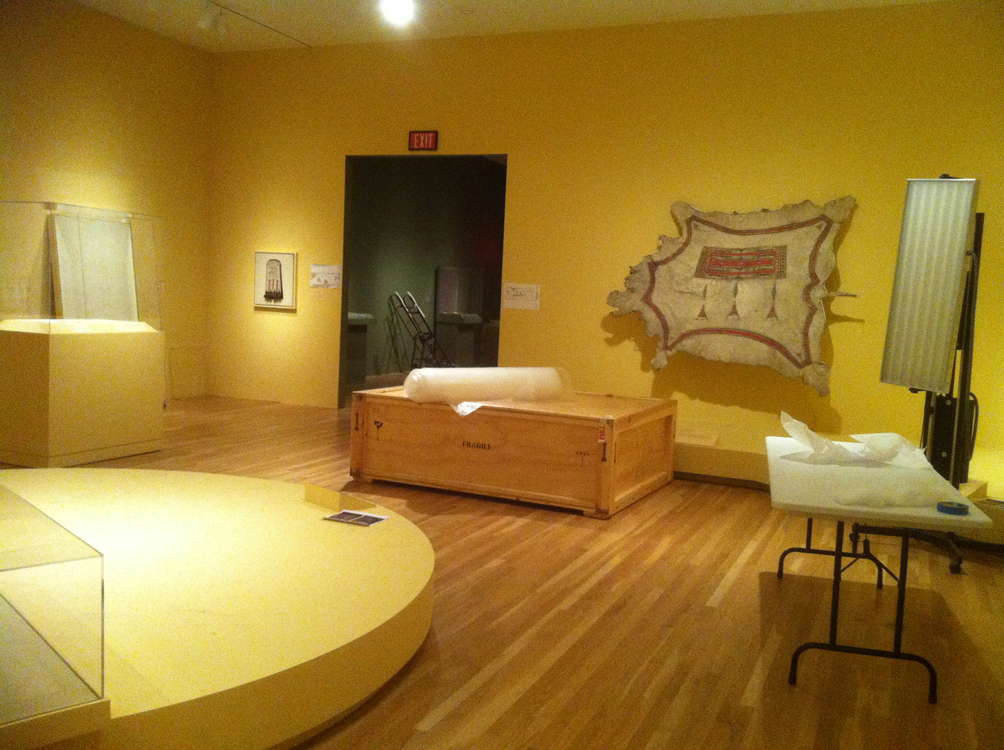
Our last venue, the Dallas Museum of Art, ended with preparator Mary drawing a level mark on one of our more difficult to hang mounts. A seemingly simple act, but we have struggled for ages to get the Box and Border robe consistently hung at just the right angle. All we were waiting for, apparently, was a fresh perspective from a kind colleague at another venue:
We have one more stop in our tour. I am looking forward to meeting the staff at the Indianapolis Museum of Art and have no doubt they will add something new to my toolbox!
After packing and installing our traveling exhibition, Art of the American Indians: The Thaw Collection six times I've picked up a few things. Curator Eva Fognell and I like to think that by the time we finish the tour we may have perfected installing and packing the 111 American Indian objects we have been traveling.
At each venue we have had the pleasure of working with talented preparators who have taught us a few new tricks about art installation. The Cleveland Museum of Art staff tipped us off on new ways to coat and pad our brass mounts.
Minneapolis Museum of Art staff introduced us to the use of magnets for hanging textiles. That technique was just the thing for installing the unframed canvasses by Awenheeyoh Powless in the 8th Contemporary Iroquois Art Biennial: 4 Artists Under 30 exhibit now on display at the Fenimore Art Museum:
Our last venue, the Dallas Museum of Art, ended with preparator Mary drawing a level mark on one of our more difficult to hang mounts. A seemingly simple act, but we have struggled for ages to get the Box and Border robe consistently hung at just the right angle. All we were waiting for, apparently, was a fresh perspective from a kind colleague at another venue:
We have one more stop in our tour. I am looking forward to meeting the staff at the Indianapolis Museum of Art and have no doubt they will add something new to my toolbox!
Tuesday, September 6, 2011
Installing "4 Artists Under 30"
By Chris Rossi, Associate Curator of Exhibitions
Fenimore Art Museum's Lower Level galleries boast some very high ceilings and a sweeping staircase that one could imagine making a grand entrance on. Recently we installed some exciting new artwork that took advantage of both features.
Leah Shenandoah’s vividly painted stretched cloth sculptures float before and above the staircase, suspended from the slatted ceiling. Using this vertical space is a treat for us and provides an opportunity to create a new vantage point for our visitors and truly fill the space.
The sculptures are part of our 8th Contemporary Iroquois Art Biennial exhibit titled “4 Artists Under 30.” The exhibit features work by Lauren Jimerson, Awenheeyoh Powless, Shenandoah and Natasha Smoke Santiago. Three of the women know each other from time spent studying and creating art at the Rochester Institute of Technology. You can see a shared sensibility between Shenandoah’s bright colors and the palette used by Powless in her danced canvases. Jimerson has captured schoolmate Shenandoah in pastels. Santiago is self-taught and expresses traditional techniques in a unique way.
These young artists “take their place as the latest installment of artists coming from the land of the Haudenosaunee – witnesses to the Indian Way of Life who seek visual expression for their time and place.”
Fenimore Art Museum's Lower Level galleries boast some very high ceilings and a sweeping staircase that one could imagine making a grand entrance on. Recently we installed some exciting new artwork that took advantage of both features.
Leah explaining how her sculptures hang
Leah Shenandoah’s vividly painted stretched cloth sculptures float before and above the staircase, suspended from the slatted ceiling. Using this vertical space is a treat for us and provides an opportunity to create a new vantage point for our visitors and truly fill the space.
The sculptures are part of our 8th Contemporary Iroquois Art Biennial exhibit titled “4 Artists Under 30.” The exhibit features work by Lauren Jimerson, Awenheeyoh Powless, Shenandoah and Natasha Smoke Santiago. Three of the women know each other from time spent studying and creating art at the Rochester Institute of Technology. You can see a shared sensibility between Shenandoah’s bright colors and the palette used by Powless in her danced canvases. Jimerson has captured schoolmate Shenandoah in pastels. Santiago is self-taught and expresses traditional techniques in a unique way.
These young artists “take their place as the latest installment of artists coming from the land of the Haudenosaunee – witnesses to the Indian Way of Life who seek visual expression for their time and place.”
Thursday, August 11, 2011
A Posh Room of Requirement
By Chris Rossi, Associate Curator of Exhibitions
There is one room at Fenimore Art Museum whose entrance is limited to only some of our visitors. It’s large, by most standards. In fact, larger than some Manhattan apartments I have lived in. It houses the most innovative early 20th century technology seen in the entire museum and one of its features is a constant delight to those who experience it. Yes, the magical place I am describing is the ladies’ lounge on the second floor.
Before Stephen C. Clark offered the property as a museum for the New York State Historical Association, the 1930s neo-Georgian house served as a home. The bathroom on the second floor had all the most modern conveniences, reflecting the sanitation movement of the early 20th century. The shower, which became popular for its healthful effects, is a great example of that trend. Rather than sit in a bath using stagnant water to cleanse oneself, people were urged to engage in showering for its “stimulating action on the skin and internal organs.” Multi-head showers, like the one in our ladies’ room, were very much in fashion for their health promoting benefits. Multiple showerheads could provide a therapeutic needle spray or shower spray directed at the back, legs or kidneys.
The shower stall is a source of great interest to our female visitors, but it does not provide the same level of delight as does the scale. Is it the historic nature of the apparatus that draws praise and attention? Could it be the tasteful way it is nestled into the floor of the room, between massage table and shower stall? No, it is the pleasure visitors derive from stepping on the scale and finding they have magically shed 15 lbs. simply by walking into the ladies’ room! Our miss-adjusted scale is a great morale booster and I strongly urge you give it a go while visiting.
I feel a little guilty flaunting all this glory in front of our gentlemen visitors. I have quietly taken an after-hours look into the second floor men’s room and can find little to recommend it. Our posh room of requirement is available to ladies only and gents will have to make do with this virtual peek at the inner sanctum.
There is one room at Fenimore Art Museum whose entrance is limited to only some of our visitors. It’s large, by most standards. In fact, larger than some Manhattan apartments I have lived in. It houses the most innovative early 20th century technology seen in the entire museum and one of its features is a constant delight to those who experience it. Yes, the magical place I am describing is the ladies’ lounge on the second floor.
Before Stephen C. Clark offered the property as a museum for the New York State Historical Association, the 1930s neo-Georgian house served as a home. The bathroom on the second floor had all the most modern conveniences, reflecting the sanitation movement of the early 20th century. The shower, which became popular for its healthful effects, is a great example of that trend. Rather than sit in a bath using stagnant water to cleanse oneself, people were urged to engage in showering for its “stimulating action on the skin and internal organs.” Multi-head showers, like the one in our ladies’ room, were very much in fashion for their health promoting benefits. Multiple showerheads could provide a therapeutic needle spray or shower spray directed at the back, legs or kidneys.
The shower stall is a source of great interest to our female visitors, but it does not provide the same level of delight as does the scale. Is it the historic nature of the apparatus that draws praise and attention? Could it be the tasteful way it is nestled into the floor of the room, between massage table and shower stall? No, it is the pleasure visitors derive from stepping on the scale and finding they have magically shed 15 lbs. simply by walking into the ladies’ room! Our miss-adjusted scale is a great morale booster and I strongly urge you give it a go while visiting.
I feel a little guilty flaunting all this glory in front of our gentlemen visitors. I have quietly taken an after-hours look into the second floor men’s room and can find little to recommend it. Our posh room of requirement is available to ladies only and gents will have to make do with this virtual peek at the inner sanctum.
Tuesday, July 19, 2011
The Story Stitched In
By Chris Rossi, Associate Curator of Exhibitions
One of the pleasures of designing an exhibit is getting to know the objects to be displayed. Behind the piece itself is usually a story about the maker and their life. Sometimes that is easy to read into a piece and other times the artist only leaves clues and little else.
One of the most intriguing pieces in Fenimore Art Museum's upcoming exhibit Unfolding Stories: Culture and Tradition in American Quilts, is the Trade and Commerce quilt. Created around 1835 the quilt is an exuberant depiction of life along a major river and truly exceptional for its conception and execution. The delightful vignettes of trade and commerce on water and on land reflect the observant eye and compositional expertise of its maker, Hannah Stockton Stiles. She clearly was familiar with the maritime trade, and her accurate depiction of the boats that formed part of the river traffic is remarkable.
Who was Hannah? She was born in Trenton, New Jersey to John and Hannah Stockton. We know she was married in 1818 to John Stiles of Philadelphia. That means the Delaware River was a familiar setting for Hannah in both her childhood and married life.
She stitched her story into the quilt with some references we can only guess at. Is it possible that the figures at the lower center of the outside border represent Hannah and her family? Perhaps she kept a cow and drove to market. Did her family own any of the boats depicted on the quilt? Whatever the answers, it is clear that life along the river was a major part of who Hannah was and how her life was shaped.
One of the pleasures of designing an exhibit is getting to know the objects to be displayed. Behind the piece itself is usually a story about the maker and their life. Sometimes that is easy to read into a piece and other times the artist only leaves clues and little else.
One of the most intriguing pieces in Fenimore Art Museum's upcoming exhibit Unfolding Stories: Culture and Tradition in American Quilts, is the Trade and Commerce quilt. Created around 1835 the quilt is an exuberant depiction of life along a major river and truly exceptional for its conception and execution. The delightful vignettes of trade and commerce on water and on land reflect the observant eye and compositional expertise of its maker, Hannah Stockton Stiles. She clearly was familiar with the maritime trade, and her accurate depiction of the boats that formed part of the river traffic is remarkable.
Who was Hannah? She was born in Trenton, New Jersey to John and Hannah Stockton. We know she was married in 1818 to John Stiles of Philadelphia. That means the Delaware River was a familiar setting for Hannah in both her childhood and married life.
She stitched her story into the quilt with some references we can only guess at. Is it possible that the figures at the lower center of the outside border represent Hannah and her family? Perhaps she kept a cow and drove to market. Did her family own any of the boats depicted on the quilt? Whatever the answers, it is clear that life along the river was a major part of who Hannah was and how her life was shaped.
Tuesday, June 28, 2011
Getting from P to P
By Chris Rossi, Associate Curator of Exhibitions
Prendergast to Pollock: American Modernism from the Munson-Williams-Proctor Arts Institute represents a change in the usual exhibit fare for the Fenimore Art Museum. This foray into modernism comes from the collection of Edward W. Root, a native of Clinton New York, who had a keen eye for the emerging 20th century American art scene.
The works are colorful, engaging and sometimes challenging. Fortunately Mary Murray, curator of modern and contemporary art at the MWPAI, was on hand to give a Food For Thought tour and expand my understanding of modernism. Mary explained that over the course of the 20th century artists were making a move from strictly representational works to more abstract views and expressions of what they were painting. Traditional realistically rendered scenes or figures gave way to canvases with flat and abstracted views where paint, color, form, and sometimes the action of painting itself were central to the art.
The exhibit is a mini-course in that progression. It starts with Maurice Prendergast’s colorful Landscape with Figures and ends with two very abstract action paintings by Jackson Pollock. The experience is an enlightening journey through American Modernism as it developed and came into its own in the 20th century.
Prendergast to Pollock: American Modernism from the Munson-Williams-Proctor Arts Institute represents a change in the usual exhibit fare for the Fenimore Art Museum. This foray into modernism comes from the collection of Edward W. Root, a native of Clinton New York, who had a keen eye for the emerging 20th century American art scene.
Mary Murray (facing camera) leading the tour
The works are colorful, engaging and sometimes challenging. Fortunately Mary Murray, curator of modern and contemporary art at the MWPAI, was on hand to give a Food For Thought tour and expand my understanding of modernism. Mary explained that over the course of the 20th century artists were making a move from strictly representational works to more abstract views and expressions of what they were painting. Traditional realistically rendered scenes or figures gave way to canvases with flat and abstracted views where paint, color, form, and sometimes the action of painting itself were central to the art.
Landscape with Figures, ca. 1912
Maurice Prendergast
Munson-Williams-Proctor Arts Institute, Utica, New York
Jackson Pollock's Number 20 and Number 34, as seen in Fenimore Art Museum
The exhibit is a mini-course in that progression. It starts with Maurice Prendergast’s colorful Landscape with Figures and ends with two very abstract action paintings by Jackson Pollock. The experience is an enlightening journey through American Modernism as it developed and came into its own in the 20th century.
Tuesday, May 17, 2011
Sprint to the Finish Line
By Chris Rossi, Associate Curator of Exhibitions
This has been a busy season for the curatorial department. The Fenimore Art Museum opened on April 1 with some wonderful new offerings. Hard to believe it is already time to change out some of these exhibits. A Window Into Edward Hopper and Prendergast to Pollock: American Modernism from the Munson-Williams-Proctor Arts Institute both open Memorial Day weekend. We have been hard at work with the help of our fantastic maintenance crew, shuffling walls, laying out galleries, painting, and designing new graphics for the exhibits.
All of this activity is mirrored across the street at The Farmers’ Museum where we are simultaneously preparing New York’s Good Eats: Our Fabulous Foods for opening the same weekend. One of the joys of working for both The Farmers’ Museum and the Fenimore Art Museum is the diversity of the objects I connect with. I can go from hanging an Edward Hopper painting to filling a case with Shredded Wheat artifacts in the space of an hour. It makes for an interesting day, which helps make lighter work of a busy installation schedule.
This has been a busy season for the curatorial department. The Fenimore Art Museum opened on April 1 with some wonderful new offerings. Hard to believe it is already time to change out some of these exhibits. A Window Into Edward Hopper and Prendergast to Pollock: American Modernism from the Munson-Williams-Proctor Arts Institute both open Memorial Day weekend. We have been hard at work with the help of our fantastic maintenance crew, shuffling walls, laying out galleries, painting, and designing new graphics for the exhibits.
All of this activity is mirrored across the street at The Farmers’ Museum where we are simultaneously preparing New York’s Good Eats: Our Fabulous Foods for opening the same weekend. One of the joys of working for both The Farmers’ Museum and the Fenimore Art Museum is the diversity of the objects I connect with. I can go from hanging an Edward Hopper painting to filling a case with Shredded Wheat artifacts in the space of an hour. It makes for an interesting day, which helps make lighter work of a busy installation schedule.
Assorted objects for New York’s Good Eats. Wings anyone?
Wall of graphic samples in preparation for production
Initial layout for Prendergast to Pollock
The Great Hall gallery being painted by our wonderful painters, Pete and Chiba, in preparation for Prendergast to Pollock
Thursday, March 31, 2011
A Pit Stop for Art of the American Indians: The Thaw Collection
By Chris Rossi, Associate Curator of Exhibitions
In addition to getting ready for the upcoming season here at the Fenimore Art Museum, the curatorial team is hard at work overseeing our traveling exhibit the Art of the American Indians: The Thaw Collection. Our objects are back from the Minneapolis Institute of Art and are resting comfortably until its time to hit the road for our next stop – the Dallas Museum of Art.
For some of the objects that means getting a break from their crates and relaxing on manikins. Others are getting conservation care to make sure they look and feel their best for the Dallas venue.
The crates themselves also need maintenance. Preparator Steve Loughman and I worked with Thaw Collection Curator Eva Fognell to review the crates and repair evidence of wear and tear. Over the course of packing and repacking, truck travel and handling, crates may need reinforcement, reworking or repair. Bolts strip and foam may wiggle loose. We need to make sure all the crates are ship-shape before hitting the road.
We will soon be repacking those objects that are out of their crates. Then off they go to Dallas, with Eva and I to follow and once again oversee installation at a new venue. The exhibition opens in Dallas on April 24.
In addition to getting ready for the upcoming season here at the Fenimore Art Museum, the curatorial team is hard at work overseeing our traveling exhibit the Art of the American Indians: The Thaw Collection. Our objects are back from the Minneapolis Institute of Art and are resting comfortably until its time to hit the road for our next stop – the Dallas Museum of Art.
The parka takes a break from its crate.
For some of the objects that means getting a break from their crates and relaxing on manikins. Others are getting conservation care to make sure they look and feel their best for the Dallas venue.
Making sure all is well with the Boy’s shirt.
The crates themselves also need maintenance. Preparator Steve Loughman and I worked with Thaw Collection Curator Eva Fognell to review the crates and repair evidence of wear and tear. Over the course of packing and repacking, truck travel and handling, crates may need reinforcement, reworking or repair. Bolts strip and foam may wiggle loose. We need to make sure all the crates are ship-shape before hitting the road.
Securing loose padding inside a crate.
We will soon be repacking those objects that are out of their crates. Then off they go to Dallas, with Eva and I to follow and once again oversee installation at a new venue. The exhibition opens in Dallas on April 24.
Friday, February 18, 2011
Art Meets Opera
Chris Rossi, Associate Curator of Exhibitions
This summer will see an exciting collaboration between Opera and Art. Glimmerglass Festival, here in Cooperstown, will present Later the same Evening. This 2007 contemporary opera was the result of a joint project of the National Gallery of Art, the Clarice Smith Performing Arts Center, and the University of Maryland School of Music. The opera is inspired by 5 of Edward Hopper's paintings - Room in New York (1932), Hotel Window (1955), Hotel Room (1931), Two on the Aisle (1927), and Automat (1927). It brings the paintings to life and eventually intertwines them on a single night in New York City in 1932.
One of the arias, “Out my One Window,” serves as the inspiration for the title of Fenimore Art Museum’s upcoming Edward Hopper Exhibition, A Window Into Edward Hopper, opening May 28. The exhibition will feature early watercolors, etchings, drawings and oil paintings. These works share the same the sensibility and style that Hopper is known for - an exploration of solitude and the desire for connection.
This summer will see an exciting collaboration between Opera and Art. Glimmerglass Festival, here in Cooperstown, will present Later the same Evening. This 2007 contemporary opera was the result of a joint project of the National Gallery of Art, the Clarice Smith Performing Arts Center, and the University of Maryland School of Music. The opera is inspired by 5 of Edward Hopper's paintings - Room in New York (1932), Hotel Window (1955), Hotel Room (1931), Two on the Aisle (1927), and Automat (1927). It brings the paintings to life and eventually intertwines them on a single night in New York City in 1932.
Characters from five Edward Hopper paintings mingle in the opera “Later the Same Evening” at Manhattan School of Music. The New York Times, online edition, 12/16/08
One of the arias, “Out my One Window,” serves as the inspiration for the title of Fenimore Art Museum’s upcoming Edward Hopper Exhibition, A Window Into Edward Hopper, opening May 28. The exhibition will feature early watercolors, etchings, drawings and oil paintings. These works share the same the sensibility and style that Hopper is known for - an exploration of solitude and the desire for connection.
East Side Interior, 1922
Etching by Edward Hopper, on loan from the Munson-Williams-Proctor Arts Institute, Utica, New York
Tuesday, February 1, 2011
Quick Change Artists
By: Chris Rossi, Associate Curator of Exhibitions
Although Fenimore Art Museum is closed to the public until April 1, the galleries are in flux right now. As with the snow-covered landscape outside, it would be easy for those in the outside world to think that we are mimicking the local wildlife and are snug in our burrows waiting for the spring thaw. But there is life under the snow and there is plenty of life in our seemingly dormant museum. We are doing our big seasonal swap, which translates into taking down last year’s exhibits, bidding a fond farewell to paintings and objects that came on loan to us, and launching new exhibits for the 2011 season.
Truth be told, doing this strenuous work while we are closed is a logistical pleasure. Right now there is a lot of open gallery space to work with and no worries about making sure the public has room to navigate safely through our mess. Once we open on April 1, it becomes more of a challenge. Keeping that in mind we try to design galleries that are “change friendly.” One of this year’s big quick-change areas will be our Great Hall. We start the season with The Spirit of Land and Tradition, which is comprised of objects from our Eugene and Clare Thaw Collection of American Indian Art. Later in the spring we switch to Prendergast to Pollock: American Modernism from the Munson-Williams-Proctor Art Institute* (opens May 28), and then back to the The Spirit of Land and Tradition in the fall (opens October 1), all while open to the public.
One way will we manage the changes is by using color and design elements in the gallery to imply change without involving dramatic physical change. The perimeter walls will stay the same color for the entire year. Freestanding walls will be added for Prendergast to Pollock in different colors to transform the space. The aim is to make the transitions go as smoothly as possible and keep the maximum amount of gallery space open and accessible to our visitors.

Design view of Great Hall for The Spirit of Land and Tradition

Design view of Great Hall for Prendergast to Pollock
*This traveling exhibition was organized by the Munson-Williams-Proctor Arts Institute Museum of Art, Utica, New York. The national tour sponsor for the exhibition is the MetLife Foundation. The Henry Luce Foundation provided funding for the conservation of artworks in the exhibition.
Subscribe to:
Posts (Atom)