Showing posts with label Kate Betz. Show all posts

Wednesday, July 1, 2009

Let’s go out to the lobby…or maybe into it, because of the rain!

By: Kate Betz, Manager of Public Programs
Last week, I had the pleasure of hosting our first ever (at least in the memory of everyone I have asked) outdoor movie on the back lawn of the Fenimore Art Museum. For the next three weeks, we will be hosting movies every Wednesday night. I have to send huge thanks to everyone who came out for their patience with our new format and most especially with the weather. We had a rain plan in place just in case, and it’s a good thing we did. Just as Princess Ann’s royal parents were sending incognito spies to track her down, rain drops began to fall. We had to pause the movie, bring everyone inside, and get set up in our auditorium. Luckily, we managed to get inside before the real rain started. This year’s outdoor series is titled “Americans Abroad.” All of the movies offer a different perspective on Americans traveling to foreign countries—from news reporter to comedic swindler. Each evening features lawn games (watch out, I’m a bocce champion!) and snacks as well as one of the most spectacular views of Otsego Lake in town. Check our website for the complete schedule. I hope to see you there!

Tuesday, April 14, 2009

Thanks for Helping Us Discover Hidden Treasures!

by: Kajsa Sabatke & Kate Betz
April 4 turned out to be a blustery, snowy day more reminiscent of winter than spring. Thanks to those enthusiastic visitors who came to the museums and joined the staff in Getting Ready for Spring at The Farmers’ Museum and discovering Hidden Treasures at the Fenimore Art Museum!

Congratulations to the winners of the prize drawings:

Gala tickets: Maureen Heffner
Family Fun package: Rudy Fedrizzi
Social Life package: Ester Winsjansen

Tuesday, April 7, 2009

Cooperstown Pursuit #4

by: Kate Betz, Manager of Public Programs
Who chooses to put their initials on their house?

In 1804, William Cooper built the first stone house in the village for his daughter Ann and her husband George Pomeroy. Originally known as “Deacon Place” because of Pomeroy’s respected position in the church, it is now popularly known as Pomeroy Place. Jamie Allen, a Scottish immigrant and stone mason, chose the unusual herringbone design and combination of initials. He was remembered as saying that a couple’s life “like the initials of the bride and groom should be so entwined as to make their union permanent.”
left: Washington Smith photo of Pomeroy Place, Florence Ward Collection, NYSHA Library
Right: Milo Stewart photo of Pomeroy Place, Florence Ward Collection, NYSHA Library

Thursday, April 2, 2009

Cooper’s Legacy in Land and Lore

By: Kate Betz, Manager of Public Programs
While Cooperstown’s geography hasn’t physically changed due to the influence of any of its citizens, the history and lore surrounding the town has been profoundly affected by one man: James Fenimore Cooper. Locations throughout Cooperstown and around Otsego Lake still bear the influence—both in name and description—of Cooper’s fictional vision of the area as seen in his five Leatherstocking novels.

This early stereoscopic view shows the site that inspired Natty Bumppo’s cave in Cooper’s The Pioneers. To call the location a “cave” is in fact a misnomer. It is actually merely a natural chasm with no interior section. However, it has become forever associated with James Fenimore Cooper and continues to delight hikers who stumble upon it to this day.

Cooper’s names and influence stretch well beyond geographic features. Not only Natty Bumppo, but Pathfinder, Deerslayer, Leatherstocking, and others have found a permanent home in Cooperstown’s street signs, lake-cruising boats, trolleys and institutions.

Cooper’s stories have also been the inspiration for countless artists since the nineteenth century. To learn more about his influence on 19th-century painters, visit the Fenimore Art Museum on April 4th for our Hidden Treasures event.
Top: Bumppo's Cave, ca. 1870. Robert Dennis Collection of Stereoscopic Views, Photography Collection, Miriam & Ira D. Wallach Division of Art, Prints & Photographs, The New York Public Library.
Bottom: Natty Bumppo II, Otsego Lake, ca. 1865. Smith and Telfer Collection, Fenimore Art Museum, Cooperstown, NY.

Tuesday, March 17, 2009

From House to Home for Great Art

By: Kate Betz, Manager of Public Programs
The name Harry St. Clair Zogbaum conjures up a number of images in my head: tweed coats and bowler hats, afternoon teas, and Colonial Revival structures built in Cooperstown in the 1930s. When Edward Severin Clark, brother of our museum’s founder Stephen Carlton Clark, decided to build the commanding estate that would eventually become the Fenimore Art Museum, he selected Zogbaum as his architect. Zogbaum had worked extensively in the Cooperstown area during the 1920s and 1930s and was well known both for his Colonial Revival style and for his use of local materials. In fact, the stones used to build Fenimore House came from nearby abandoned mills.

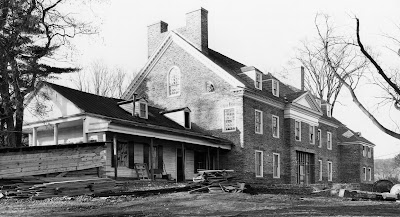
Construction likely began in mid-1929 or early 1930. Zogbaum had drafted plans that created a grand estate with many classic features. The house contained 46 rooms including the usual expectations for a house of this size—multiple bedrooms, a study, library, ballroom—but also a few less usual features including a basement level indoor pool. The plans included – at least initially - keeping intact the cottage structure which currently stood on the property and which had been built by James Fenimore Cooper. Arthur Telfer took the first photos of the new house, including the one below, which were dated on the back November 14, 1930. They show the house partially complete with the old “Fenimore” cottage attached as a south wing. (Later the cottage was torn down and replaced.)
The house was finished late in 1932 and its occupant hosted a number of holiday parties to celebrate the completion. Sadly, Edward S. Clark died unexpectedly September 19, 1933, after living in the house for only 9 months. By the terms of his will, the farm and house passed to his brother Stephen C. Clark who, eleven years later, would donate the home to the New York State Historical Association for use as a museum space.

The process of turning a private home into a modern museum was a formidable one, but was made much simpler because of Zogbaum’s help. Zogbaum designed the modifications for the house that would pave the way for what we now know as the Fenimore Art Museum. Bedrooms, library, ballroom and even the pool were all converted into gallery and office space.
This original house blueprint is one of my favorite objects in our collection. You can see where it has been relabeled in red pencil to demonstrate where all of the museum’s galleries should go. I don’t know that I could say why this object above any other is my particular favorite. I think it just creates such a unique visual perspective on the creation of a museum that I had never before considered. How would you go about deciding whether the dining room or the library was the ideal location for a new museum’s collection of James Fenimore Cooper ephemera? What is in fact the most efficient way to turn an attic into a proper collections storage area?

Looking at the blueprint, I can almost picture the many hands that have not only touched it in particular, but that have helped to create the museum that I now walk through every day I come to work.
top: Arthur Telfer, Fenimore House under construction, November 14, 1930. Smith and Telfer Collection, New York State Historical Association.
bottom: Original Fenimore House blueprint, NYSHA Library Special Collections.

Thursday, March 12, 2009

Hidden Treasures on Display

By: Kate Betz, Manager of Public Programs
Did you know that the Fenimore Art Museum’s collection has some of finest examples of American art in the country? Many of these spectacular works are often on loan to other museums for their exhibitions. You've may have walked past some of these paintings in the museum's'= galleries before and noticed their beauty, but you might not have known just how important they are in the field of art history. This year, on April 4th, we’re bringing our Hidden Treasures to the forefront. Interested visitors can pick up a series of questions to answer about some of our greatest pieces of art. For each completed question, you will receive one ticket good for a chance to win one of several prize packages which will feature tickets for admission, workshops, and special events, as well as items from our shops and from area merchants.

Each week, this blog will feature clues and information that will be related to the activities and questions of our April 4th event. And if clues weren’t enough, one week prior to the event, we will be posting a link on the blog to a downloadable version of our trivia quiz with a bonus question that will only be available online. Hidden Treasures will feature tours and activities throughout the day in addition to the quiz and is a perfect day out for families, couples, or individuals who like a bit of a challenge and like to win prizes. Make sure to stay tuned for your first clues!

Thursday, February 26, 2009

Cooperstown Pursuit #2

By: Kate Betz, Manager of Public Programs
The story of William and Elizabeth Cooper’s arrival in Cooperstown has been the subject of many exaggerations and complications throughout the town’s history. In fact, so much has been made of their arrival that it was even thought to be a worthy subject of “Ripley’s-Believe it or Not.” Mrs. Cooper is, in their cartoon, the first person to stage a “sit-down strike” to avoid moving from her more comfortable home in New Jersey. (click to enlarge cartoon)
Though a good story, the cartoon lacks historical evidence. When William Cooper brought his wife Elizabeth to his settlement on the banks of Otsego Lake, the couple did indeed travel over rough terrain and uneven roads, even completing their journey by canoe. Elizabeth hated the journey so much that she refused to leave the town until a new road was cut. (No word on whether she was sitting down while delivering this refusal to her husband.) She did not have to wait for long to be able to travel on improved roads. By the turn of the nineteenth century, residents dramatically improved the rough road when “a good Turnpike Road westward from Cooperstown to the Chenango River” was completed, and a stage coach route between Cooperstown and Canajoharie provided travelers with frequent and reliable opportunities for travel outside of the quickly expanding town.
Cartoon: 20th century, Vertical File, NYSHA Research Library.

Tuesday, February 10, 2009

Art Speculations from the Non-Curator

By: Kate Betz, Manger of Public Programs
I grew up with two ideas of Rome in my head.

Idea 1: Rome was the birthplace of democracy and its great buildings (now relics) should be celebrated—nay, enshrined—as icons to be lauded.

Idea 2: Rome was full of drunken debauchery, violence, and anything except democracy.

Our museum curators recently showed me some of the amazing paintings that will be featured in this summer’s exhibit America’s Rome. To me, these paintings represent part of the dichotomy of Rome that has been a part of the American collective consciousness throughout my life. I think that Idea 1 is the inspiration that drove most of the paintings that I’ve seen of the exhibit so far. An amazing society grew and flourished right there where these nineteenth-century American painters stood painting landscapes. Though this society is gone, the remnants of it remain, and these remnants are still worth preserving.

As far as Idea 2 is concerned, I think that Rome as a debauchery is appealing for the same reason that I like to hear about the quirks of famous people. Call me crazy, but I like knowing that everyone has flaws and yet our society continues to function and progress continues to be made. Those Romans sure could party, but they could also create an unparalleled system of aqueducts and some really stellar philosophers along the way. Now, it is possible, of course, that the only reason I have this idea in my head is because I just finished watching Season 2 of HBO’s miniseries Rome last week. However, if Thomas Cole’s series Course of Empire is any indication, I think that these painters were struggling with the same thing. I could just be making this up, but these simply remain, speculations from the non-curator…

Thursday, January 29, 2009

Cooperstown Pursuit #1

By: Kate Betz, Manager of Public Programs
Though many people may think of the current Fenimore Art Museum building as the only building that has ever stood on this property, this is actually far from true. One of the first people to live on this property was none other than novelist James Fenimore Cooper.

This lovely cottage became the home of James and his family during their early days in Cooperstown. While living in the small cottage, Cooper was in the process of constructing a new stone manor house. If you’re familiar with the area, it would have been located on the lake side of the Leatherstocking Golf Course across from where the Schoolhouse now stands at The Farmers’ Museum.

Susan Cooper, James’ daughter, remembered the building process in a story meant for her children: “I remember distinctly going with them to the new stone house, then building. In that house they expected to pass their lives. But in fact it was never inhabited. Your grandfather one day chose an even stone, to be placed in the wall, and carved on it his own name and that of your grandmother, with the date—1816.”

Indeed, the family never lived in the house. As it turns out, economic recessions are nothing new in this country, and because of declining Cooper finances and the recent death of James’ mother, the family moved to Westchester County and the house stood empty.

In 1823, the stone house—likely the original structure to be given the name “Fenimore”—was badly damaged by a fire. As it turns out, arsonists are also nothing new in this country either.

In spite of this spate of bad luck, the stone manor’s building materials were not wasted. In 1826, the stones from the manor house were used in the construction of the twin stone buildings that can still be seen today at 51 and 53 Pioneer Street in the village of Cooperstown. An early example of recycling at its finest!

Thursday, December 4, 2008

What's your favorite toy?

By: Kate Betz, Manager of Public ProgramsAll during the month of December, the Fenimore Art Museum is celebrating childhood and play through history. We've mined our collection for the best examples of historic toys--but even more exciting are the samples of today's favorite toys, made possible by the participation of second grade students from the Cooperstown Central School.

What struck me the most when reading all of the students' labels was how the simple toys are still the best. Stuffed animals, blocks, and dolls were the clear winners. Though my personal favorite--the Playdoh Fun Factory--did not make an appearance, I was still extremely proud of all the thought that the students put into their selection. On Tuesday evening, the museum was filled with students, parents, and extended family to proudly pose in front of their labels and discuss their work over milk and cookies. It was a great night and a great finish to a fun project.

Make sure to visit the museum this month to read all about their favorite toys and strike up a conversation with your own family about your "couldn't-live-without" toy from childhood.

Blog Widget by LinkWithin