
by: Kajsa Sabatke & Kate Betz
April 4 turned out to be a blustery, snowy day more reminiscent of winter than spring. Thanks to those enthusiastic visitors who came to the museums and joined the staff in Getting Ready for Spring at The Farmers’ Museum and discovering Hidden Treasures at the Fenimore Art Museum!
Congratulations to the winners of the prize drawings:
Gala tickets: Maureen Heffner
Family Fun package: Rudy Fedrizzi
Social Life package: Ester Winsjansen
Showing posts with label Hidden Treasures. Show all posts
Showing posts with label Hidden Treasures. Show all posts
Tuesday, April 14, 2009


Thursday, April 2, 2009
Cooper’s Legacy in Land and Lore
By: Kate Betz, Manager of Public Programs  This early stereoscopic view shows the site that inspired Natty Bumppo’s cave in Cooper’s The Pioneers. To call the location a “cave” is in fact a misnomer. It is actually merely a natural chasm with no interior section. However, it has become forever associated with James Fenimore Cooper and continues to delight hikers who stumble upon it to this day.
Cooper’s names and influence stretch well beyond geographic features. Not only Natty Bumppo, but Pathfinder, Deerslayer, Leatherstocking, and others have found a permanent home in Cooperstown’s street signs, lake-cruising boats, trolleys and institutions.
.jpg) Cooper’s stories have also been the inspiration for countless artists since the nineteenth century. To learn more about his influence on 19th-century painters, visit the Fenimore Art Museum on April 4th for our Hidden Treasures event.
Cooper’s stories have also been the inspiration for countless artists since the nineteenth century. To learn more about his influence on 19th-century painters, visit the Fenimore Art Museum on April 4th for our Hidden Treasures event.
While Cooperstown’s geography hasn’t physically changed due to the influence of any of its citizens, the history and lore surrounding the town has been profoundly affected by one man: James Fenimore Cooper. Locations throughout Cooperstown and around Otsego Lake still bear the influence—both in name and description—of Cooper’s fictional vision of the area as seen in his five Leatherstocking novels.
This early stereoscopic view shows the site that inspired Natty Bumppo’s cave in Cooper’s The Pioneers. To call the location a “cave” is in fact a misnomer. It is actually merely a natural chasm with no interior section. However, it has become forever associated with James Fenimore Cooper and continues to delight hikers who stumble upon it to this day.Cooper’s names and influence stretch well beyond geographic features. Not only Natty Bumppo, but Pathfinder, Deerslayer, Leatherstocking, and others have found a permanent home in Cooperstown’s street signs, lake-cruising boats, trolleys and institutions.
Cooper’s stories have also been the inspiration for countless artists since the nineteenth century. To learn more about his influence on 19th-century painters, visit the Fenimore Art Museum on April 4th for our Hidden Treasures event. Top: Bumppo's Cave, ca. 1870. Robert Dennis Collection of Stereoscopic Views, Photography Collection, Miriam & Ira D. Wallach Division of Art, Prints & Photographs, The New York Public Library.
Bottom: Natty Bumppo II, Otsego Lake, ca. 1865. Smith and Telfer Collection, Fenimore Art Museum, Cooperstown, NY.
Monday, March 30, 2009
Hidden Treasures: Activity Sheet Now Available!
 Find Hidden Treasures at the Museum on April 4! The activity sheet is now available on our website and it contains a bonus question that is only included on this special version.
 We hope you’ll print out our activity sheet, check our recent blog posts for hints, and come to Fenimore Art Museum on April 4 to help us get ready for spring!
Thursday, March 26, 2009
Beacon Lights
By: John Buchinger, Associate Director of Education
Working at an art museum, I see amazing things every day, and sometimes I only realize how special they are when someone else points them out. Though all of our pieces could be celebrated in this post, one object in particular shines above the others.
Working at an art museum, I see amazing things every day, and sometimes I only realize how special they are when someone else points them out. Though all of our pieces could be celebrated in this post, one object in particular shines above the others.
 The Beacon Lights basket, a Washoe basket by famed Native artist Louisa Keyser, has been selected to be a part of the National Endowment for the Humanities’ newest initiative of its We the People program Picturing America. The basket is made out of willow, western redbud, and bracken fern root, and is the most historically significant basket of Keyser’s career and the one most widely referred to in publications on this famed Washoe weaver. Keyser’s mastery of the medium is revealed in the control of the extremely fine stitches of weaving and the elegant balance of her design as it moves over a constantly changing surface. Beacon Lights epitomizes Louisa Keyser’s greatest work.
Picturing America was launched in February 2007. This program distributes large, high quality reproductions of selected works of American art, along with a teacher resource book, lesson plans, and materials, to K-12 schools and public libraries.
We were incredibly thrilled to hear that not only Beacon Lights, but also our Black Hawk Sans Arc Lakota Ledger Book were both selected to be a part of this fantastic art education program. It calls national attention to our collections and shares our greatest hidden treasures with audiences across the country.
Beacon Lights, by Louisa Keyser (ca.1850-1925). Fenimore Art Museum, Cooperstown, NY. Gift of Eugene Victor Thaw Art Foundation. T0751
Tuesday, March 24, 2009
Otsego Lake Paintings
By: Michelle Murdock, Curator of Exhibitions
 Fenimore Art Museum holds numerous artifacts related to Otsego Lake, including several dozen drawings, prints and paintings and hundreds of photographs. Of the more than twelve paintings that come immediately to mind for me, my favorites include Cooperstown Winter Carnival by Janet Munro and Lake Party at Three Mile Point by Julius Gollmann and Louis Remy Mignot. On my daily commute to work, I pass by the Lake’s public-access Three Mile Point Park and I often picture the Lake Party painting in my mind. The painting is the combined work of Louis Remy Mignot and Julius Gollmann, two artists who spent the summer of 1855 in Cooperstown. Mignot painted the landscape in his meticulous Hudson River School style, while the figures were completed by Gollmann, a German portraitist. What I especially like about the painting, though, is the inclusion of many of Cooperstown’s notables around the time when the Point was purchased by the town for the benefit of the public. Included is Judge Samuel Nelson, who was an Associate Justice of the United States Supreme Court from 1845 to 1872.

Fenimore Art Museum strives to collect artifacts of local importance. Its Otsego Lake views, including the recently-acquired Otsego Lake by Thomas Hicks, are among its great American treasures. Four of our Otsego Lake paintings are on view in Fenimore Art Museum until May 6th. You can learn more about Otsego Lake in Otsego Lake: Past and Present available from our Museum Shops.
Do you know what I can see from my office window? I’m incredibly fortunate to look out and see one of the most beautiful, and most well-known, lakes in the United States. Fenimore Art Museum sits on the west shore of Otsego Lake, commonly known as Glimmerglass. James Fenimore Cooper coined its nickname in his early 19th -century novels. In fact, Cooper’s portrayal of the Lake in The Pioneers, was the first example in an American novel of a view of nature as something beautiful to be preserved instead of a threatening obstacle to be overcome.
Fenimore Art Museum holds numerous artifacts related to Otsego Lake, including several dozen drawings, prints and paintings and hundreds of photographs. Of the more than twelve paintings that come immediately to mind for me, my favorites include Cooperstown Winter Carnival by Janet Munro and Lake Party at Three Mile Point by Julius Gollmann and Louis Remy Mignot. On my daily commute to work, I pass by the Lake’s public-access Three Mile Point Park and I often picture the Lake Party painting in my mind. The painting is the combined work of Louis Remy Mignot and Julius Gollmann, two artists who spent the summer of 1855 in Cooperstown. Mignot painted the landscape in his meticulous Hudson River School style, while the figures were completed by Gollmann, a German portraitist. What I especially like about the painting, though, is the inclusion of many of Cooperstown’s notables around the time when the Point was purchased by the town for the benefit of the public. Included is Judge Samuel Nelson, who was an Associate Justice of the United States Supreme Court from 1845 to 1872.Fenimore Art Museum strives to collect artifacts of local importance. Its Otsego Lake views, including the recently-acquired Otsego Lake by Thomas Hicks, are among its great American treasures. Four of our Otsego Lake paintings are on view in Fenimore Art Museum until May 6th. You can learn more about Otsego Lake in Otsego Lake: Past and Present available from our Museum Shops.
Top: Lake Party at Three Mile Point, Otsego Lake, New York, ca. 1855. By Louis Remy Mignot and Julius Gollmann. N0341.1955
Bottom: Otsego Lake, 1862. By Thomas Hicks. N0018.2006(01)
Thursday, March 19, 2009
Bear and Pears Fireboard
By: Paul D'Ambrosio, Vice-President and Chief Curator
Can a simple board and batten construction, meant to cover a fireplace in the summer months and painted with the edges of a rag or even a sponge, be considered an icon of American art? The Fenimore Art Museum’s Bear and Pears fireboard is just such a piece. In the past 150+ years this work has gone from gracing the parlor of a rural home in New Hampshire to the more auspicious homes of a series of astute collectors that included a famous modernist sculptor (Elie Nadelman) and a pioneering scholar/author (Jean Lipman) to its current museum setting.
 Why is this fireboard considered a great work of art? The unknown artist who painted the picture followed the guidelines of tastemaker Rufus Porter, who published a book in the 1820s (titled Curious Arts) and a series of articles in Scientific American in the 1840s on how to do mural painting and simple, effective decoration. Everything in Bear and Pears is on the horizon line, objects are made different sizes to give the illusion of depth, and the artist used a rag or sponge and stencils to paint faster. The result may be out of line with what we consider realism – the “pears” are larger than the house – but the balance of forms and colors is striking. It’s no wonder that so many of these untrained artists created works that bend the rules of realism; it requires a lot of training and experience to make a painting a “window” into the observed world. It is a testament to their innate artistic ability that the works these folk artists made were sought after by connoisseurs of modernism and eventually enshrined in museum collections.
Unknown Artist. Bears and Pears Fireboard, c.1825-1835. Fenimore Art Museum, Cooperstown, NY. Gift of Stephen C. Clark, N0044.1961
Can a simple board and batten construction, meant to cover a fireplace in the summer months and painted with the edges of a rag or even a sponge, be considered an icon of American art? The Fenimore Art Museum’s Bear and Pears fireboard is just such a piece. In the past 150+ years this work has gone from gracing the parlor of a rural home in New Hampshire to the more auspicious homes of a series of astute collectors that included a famous modernist sculptor (Elie Nadelman) and a pioneering scholar/author (Jean Lipman) to its current museum setting.
Why is this fireboard considered a great work of art? The unknown artist who painted the picture followed the guidelines of tastemaker Rufus Porter, who published a book in the 1820s (titled Curious Arts) and a series of articles in Scientific American in the 1840s on how to do mural painting and simple, effective decoration. Everything in Bear and Pears is on the horizon line, objects are made different sizes to give the illusion of depth, and the artist used a rag or sponge and stencils to paint faster. The result may be out of line with what we consider realism – the “pears” are larger than the house – but the balance of forms and colors is striking. It’s no wonder that so many of these untrained artists created works that bend the rules of realism; it requires a lot of training and experience to make a painting a “window” into the observed world. It is a testament to their innate artistic ability that the works these folk artists made were sought after by connoisseurs of modernism and eventually enshrined in museum collections.Unknown Artist. Bears and Pears Fireboard, c.1825-1835. Fenimore Art Museum, Cooperstown, NY. Gift of Stephen C. Clark, N0044.1961
Tuesday, March 17, 2009
From House to Home for Great Art
By: Kate Betz, Manager of Public Programs
 The house was finished late in 1932 and its occupant hosted a number of holiday parties to celebrate the completion. Sadly, Edward S. Clark died unexpectedly September 19, 1933, after living in the house for only 9 months. By the terms of his will, the farm and house passed to his brother Stephen C. Clark who, eleven years later, would donate the home to the New York State Historical Association for use as a museum space.
The process of turning a private home into a modern museum was a formidable one, but was made much simpler because of Zogbaum’s help. Zogbaum designed the modifications for the house that would pave the way for what we now know as the Fenimore Art Museum. Bedrooms, library, ballroom and even the pool were all converted into gallery and office space.
 This original house blueprint is one of my favorite objects in our collection. You can see where it has been relabeled in red pencil to demonstrate where all of the museum’s galleries should go. I don’t know that I could say why this object above any other is my particular favorite. I think it just creates such a unique visual perspective on the creation of a museum that I had never before considered. How would you go about deciding whether the dining room or the library was the ideal location for a new museum’s collection of James Fenimore Cooper ephemera? What is in fact the most efficient way to turn an attic into a proper collections storage area?
Looking at the blueprint, I can almost picture the many hands that have not only touched it in particular, but that have helped to create the museum that I now walk through every day I come to work.
The name Harry St. Clair Zogbaum conjures up a number of images in my head: tweed coats and bowler hats, afternoon teas, and Colonial Revival structures built in Cooperstown in the 1930s. When Edward Severin Clark, brother of our museum’s founder Stephen Carlton Clark, decided to build the commanding estate that would eventually become the Fenimore Art Museum, he selected Zogbaum as his architect. Zogbaum had worked extensively in the Cooperstown area during the 1920s and 1930s and was well known both for his Colonial Revival style and for his use of local materials. In fact, the stones used to build Fenimore House came from nearby abandoned mills.
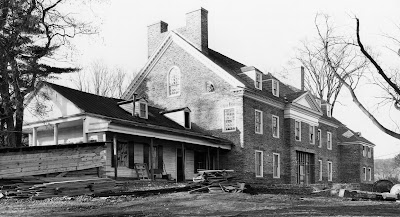
Construction likely began in mid-1929 or early 1930. Zogbaum had drafted plans that created a grand estate with many classic features. The house contained 46 rooms including the usual expectations for a house of this size—multiple bedrooms, a study, library, ballroom—but also a few less usual features including a basement level indoor pool. The plans included – at least initially - keeping intact the cottage structure which currently stood on the property and which had been built by James Fenimore Cooper. Arthur Telfer took the first photos of the new house, including the one below, which were dated on the back November 14, 1930. They show the house partially complete with the old “Fenimore” cottage attached as a south wing. (Later the cottage was torn down and replaced.)
Construction likely began in mid-1929 or early 1930. Zogbaum had drafted plans that created a grand estate with many classic features. The house contained 46 rooms including the usual expectations for a house of this size—multiple bedrooms, a study, library, ballroom—but also a few less usual features including a basement level indoor pool. The plans included – at least initially - keeping intact the cottage structure which currently stood on the property and which had been built by James Fenimore Cooper. Arthur Telfer took the first photos of the new house, including the one below, which were dated on the back November 14, 1930. They show the house partially complete with the old “Fenimore” cottage attached as a south wing. (Later the cottage was torn down and replaced.)
The house was finished late in 1932 and its occupant hosted a number of holiday parties to celebrate the completion. Sadly, Edward S. Clark died unexpectedly September 19, 1933, after living in the house for only 9 months. By the terms of his will, the farm and house passed to his brother Stephen C. Clark who, eleven years later, would donate the home to the New York State Historical Association for use as a museum space. The process of turning a private home into a modern museum was a formidable one, but was made much simpler because of Zogbaum’s help. Zogbaum designed the modifications for the house that would pave the way for what we now know as the Fenimore Art Museum. Bedrooms, library, ballroom and even the pool were all converted into gallery and office space.
This original house blueprint is one of my favorite objects in our collection. You can see where it has been relabeled in red pencil to demonstrate where all of the museum’s galleries should go. I don’t know that I could say why this object above any other is my particular favorite. I think it just creates such a unique visual perspective on the creation of a museum that I had never before considered. How would you go about deciding whether the dining room or the library was the ideal location for a new museum’s collection of James Fenimore Cooper ephemera? What is in fact the most efficient way to turn an attic into a proper collections storage area?Looking at the blueprint, I can almost picture the many hands that have not only touched it in particular, but that have helped to create the museum that I now walk through every day I come to work.
top: Arthur Telfer, Fenimore House under construction, November 14, 1930. Smith and Telfer Collection, New York State Historical Association.
bottom: Original Fenimore House blueprint, NYSHA Library Special Collections.
Thursday, March 12, 2009
Hidden Treasures on Display
By: Kate Betz, Manager of Public Programs
Did you know that the Fenimore Art Museum’s collection has some of finest examples of American art in the country? Many of these spectacular works are often on loan to other museums for their exhibitions. You've may have walked past some of these paintings in the museum's'= galleries before and noticed their beauty, but you might not have known just how important they are in the field of art history. This year, on April 4th, we’re bringing our Hidden Treasures to the forefront. Interested visitors can pick up a series of questions to answer about some of our greatest pieces of art. For each completed question, you will receive one ticket good for a chance to win one of several prize packages which will feature tickets for admission, workshops, and special events, as well as items from our shops and from area merchants.
Each week, this blog will feature clues and information that will be related to the activities and questions of our April 4th event. And if clues weren’t enough, one week prior to the event, we will be posting a link on the blog to a downloadable version of our trivia quiz with a bonus question that will only be available online. Hidden Treasures will feature tours and activities throughout the day in addition to the quiz and is a perfect day out for families, couples, or individuals who like a bit of a challenge and like to win prizes. Make sure to stay tuned for your first clues!
Did you know that the Fenimore Art Museum’s collection has some of finest examples of American art in the country? Many of these spectacular works are often on loan to other museums for their exhibitions. You've may have walked past some of these paintings in the museum's'= galleries before and noticed their beauty, but you might not have known just how important they are in the field of art history. This year, on April 4th, we’re bringing our Hidden Treasures to the forefront. Interested visitors can pick up a series of questions to answer about some of our greatest pieces of art. For each completed question, you will receive one ticket good for a chance to win one of several prize packages which will feature tickets for admission, workshops, and special events, as well as items from our shops and from area merchants.
Each week, this blog will feature clues and information that will be related to the activities and questions of our April 4th event. And if clues weren’t enough, one week prior to the event, we will be posting a link on the blog to a downloadable version of our trivia quiz with a bonus question that will only be available online. Hidden Treasures will feature tours and activities throughout the day in addition to the quiz and is a perfect day out for families, couples, or individuals who like a bit of a challenge and like to win prizes. Make sure to stay tuned for your first clues!
Subscribe to:
Posts (Atom)


