By John Hart, Assistant Curator of Collections
Having worked at the Fenimore Art Museum and The Farmers' Museum storage facility for over three years now, there isn’t too much that surprises me when I stumble across it on a shelf. Except for a box of dozens of cameos. And not the cameo pins like most people are familiar with; these are plaster, and used to be glued into the trays in which they’re still contained. I’ve questioned for a few months now “What exactly are these?” They’re not jewelry, but they’re so small they can’t possibly be art to hang on a wall, unless you live in a doll house.
Well, looking under the lid helps.
The label is in Italian, and I’ll be honest, I haven’t spoken a complete sentence in Italian in over 20 years. Thank you Google! Given the translation of the first few words I figured out that this is a sample box of a cameo artists work, and the artist’s name was Giovanni Liberotti. I butchered the translation, even online, of the rest of the label, but it appears that the artist gathered the likenesses of other cameos and recreated them, showing off his own talent. Sort of an early artist’s portfolio I suppose, to help the artist have more work.
For some reason it never occurred to me until today that something like this sample set would have ever existed, but it certainly brings up other questions that the historian in me wishes could be answered. Was this kit brought from Italy by the artist to find work in America? Did someone find it in a dusty shop somewhere in Rome and bring it back as a souvenir? Who was Giovanni Liberotti? (I found a few answers to that question thanks to Google again!) In any event, it’s a very nice set of sample pieces that I can’t wait to work with a little more!
Cameos, Givoanni Liberotti, Plaster, various sizes, N0146.1969.
Showing posts with label Farmers' Museum. Show all posts
Tuesday, November 1, 2011
Friday, August 26, 2011
Firefighting in the 19th Century
By John Hart, Assistant Curator of Collections
Over the past several months, the curatorial staff has been busy moving things around in the basement of the storage facility to make way for upgrades to the ventilation system. While doing so, we’ve uncovered quite a few things, including the image below.
Having more or less grown up at the firehouse at which my father volunteered, I’m not a stranger to old fire apparatuses. I used to pull an early hose cart in my hometown parades and even got in trouble one day when I pumped the siren control on the old Mack fire engine and it came screaming to life, much to everyone’s shock and surprise (the siren hadn’t worked on the truck in years and somehow I figured out how to make it work).
For the 2007 season, Fenimore Art Museum had an exhibit titled Folk Art on Fire, which exhibited early fire fighting and fire-related folk art. It was a fascinating exhibit and one that I truly enjoyed. It was at that time that I was able to get my first good look at the fire pumper, Neptune, which our sister museum, The Farmers’ Museum, has in its collection. Dating between 1820 and 1830, this pumper, seen below, was the third pumper used by the Cooperstown fire department, which acquired it around 1841 after a devastating fire in the village. It remained faithfully in service until 1901.
You’ve probably seen old fire apparatuses in parades, rusting away quietly in a field, or in museums, but it’s nice to know that photographs of the men that used that old equipment survive today and show, in some pretty striking detail, what was used before today’s technologically advanced fire trucks.
Over the past several months, the curatorial staff has been busy moving things around in the basement of the storage facility to make way for upgrades to the ventilation system. While doing so, we’ve uncovered quite a few things, including the image below.
Oneonta Fire Company, ca. 1847-1855
Having more or less grown up at the firehouse at which my father volunteered, I’m not a stranger to old fire apparatuses. I used to pull an early hose cart in my hometown parades and even got in trouble one day when I pumped the siren control on the old Mack fire engine and it came screaming to life, much to everyone’s shock and surprise (the siren hadn’t worked on the truck in years and somehow I figured out how to make it work).
For the 2007 season, Fenimore Art Museum had an exhibit titled Folk Art on Fire, which exhibited early fire fighting and fire-related folk art. It was a fascinating exhibit and one that I truly enjoyed. It was at that time that I was able to get my first good look at the fire pumper, Neptune, which our sister museum, The Farmers’ Museum, has in its collection. Dating between 1820 and 1830, this pumper, seen below, was the third pumper used by the Cooperstown fire department, which acquired it around 1841 after a devastating fire in the village. It remained faithfully in service until 1901.
Old Neptune No. 3
You’ve probably seen old fire apparatuses in parades, rusting away quietly in a field, or in museums, but it’s nice to know that photographs of the men that used that old equipment survive today and show, in some pretty striking detail, what was used before today’s technologically advanced fire trucks.
Tuesday, June 7, 2011
Interning @ Fenimore Art Museum
By Emma Porter, Curatorial Intern
Hi! My name is Emma Porter and I am a volunteer curatorial intern at the Fenimore Art Museum this summer. In December, I will graduate from S.U.N.Y Geneseo as an art history major. I am very excited to share my experience as an intern and hope it creates a space for learning, discussion and exploration.
All of the staff here at Fenimore are so helpful and they all work together as a team. Communication is critical to everyone here, and that is what makes this museum so prolific and run so effectively. For example, I was given my internship projects at a table with the Director of Exhibitions, Michelle Murdock, Associate Curator of Exhibitions, Chris Rossi and Preparator, Stephen Loughman. Each project was explained to me thoroughly and there was active dialogue amongst all of us. I love the communication; it does make the world go around! Something Michelle told me my first day was that I should look at museums and, all of my surroundings for that matter, as a curator. This is a different way of seeing and I am confident that by the end of my internship here, I will be able to “see” like a curator. There is a lot to look forward to this summer at the Fenimore, and I cannot wait to visit in the fall and in 2012 to see the final products of our research and planning.
Also notable is the close tie between the Fenimore and The Farmers’ Museum, a rural life museum that gives an up close and personal view of life in the 19th century in New York. I love the stoneware collection in the Herkimer Kitchen and the wallpaper in the Jonas More House. When you visit, be sure to take time to pet the baby sheep in the Smith Morey Barn.
Currently at the Feimore, there is the A Window into Edward Hopper exhibition in the Scriven Gallery on the second floor. It tells the story of what Hopper chose to focus on in the places he temporarily or permanently resided in New England, such as Gloucester, MA and Rockland, ME. His wife Jo was his main model for his well-known works depicting lonely people in Manhattan cityscapes and desolate interiors. The Glimmerglass Festival, just down the road from Fenimore, is adopting the opera called Later The Same Evening which is based on five on Hopper’s paintings from is Manhattan period. The exhibition at Fenimore was developed in conjunction with the Festival's production.
Projects:
I am currently looking at the work of Tasha Tudor, an icon for the “home-grown,” and “back to the old way” lifestyle. Tudor lived in Vermont and aimed to mimic a life from the rural 1830s. The Fenimore is planning an exhibition of her paintings, drawings, and holiday cards, along with other artifacts from her life. It is obvious how Tudor’s work and lifestyle are relevant to both the Fenimore Art Museum and The Farmers’ Museum. I am looking through her images that the Fenimore is borrowing from the Norman Rockwell Museum in Stockbridge, MA, and figuring out how to tie in images from the Farmers’ Museum with the labels that will be in Fenimore. For example, the label for Tudor’s In April the Birds Return (below) could feature a photograph of two of The Farmers’ Museum’s own oxen yolked and plowing the farm field.
Children and gardens are prevalent in Tudor's work. Gardens can be seen as a metaphor for the intellectual and physical growth of children. Tudor published a Caldecott Honor children’s book that counts to ten using flowers. The Farmers’ Museum has a children’s garden near the Dimmick House. To provide an connection between the Fenimore and the Farmers’ Museum, I think a children’s gardening workshop that incorporates Tudor’s work, especially her children’s books illustrations, would be a lot of fun.
I'll keep you posted as my internship progresses!
Hi! My name is Emma Porter and I am a volunteer curatorial intern at the Fenimore Art Museum this summer. In December, I will graduate from S.U.N.Y Geneseo as an art history major. I am very excited to share my experience as an intern and hope it creates a space for learning, discussion and exploration.
All of the staff here at Fenimore are so helpful and they all work together as a team. Communication is critical to everyone here, and that is what makes this museum so prolific and run so effectively. For example, I was given my internship projects at a table with the Director of Exhibitions, Michelle Murdock, Associate Curator of Exhibitions, Chris Rossi and Preparator, Stephen Loughman. Each project was explained to me thoroughly and there was active dialogue amongst all of us. I love the communication; it does make the world go around! Something Michelle told me my first day was that I should look at museums and, all of my surroundings for that matter, as a curator. This is a different way of seeing and I am confident that by the end of my internship here, I will be able to “see” like a curator. There is a lot to look forward to this summer at the Fenimore, and I cannot wait to visit in the fall and in 2012 to see the final products of our research and planning.
Also notable is the close tie between the Fenimore and The Farmers’ Museum, a rural life museum that gives an up close and personal view of life in the 19th century in New York. I love the stoneware collection in the Herkimer Kitchen and the wallpaper in the Jonas More House. When you visit, be sure to take time to pet the baby sheep in the Smith Morey Barn.
Currently at the Feimore, there is the A Window into Edward Hopper exhibition in the Scriven Gallery on the second floor. It tells the story of what Hopper chose to focus on in the places he temporarily or permanently resided in New England, such as Gloucester, MA and Rockland, ME. His wife Jo was his main model for his well-known works depicting lonely people in Manhattan cityscapes and desolate interiors. The Glimmerglass Festival, just down the road from Fenimore, is adopting the opera called Later The Same Evening which is based on five on Hopper’s paintings from is Manhattan period. The exhibition at Fenimore was developed in conjunction with the Festival's production.
Projects:
I am currently looking at the work of Tasha Tudor, an icon for the “home-grown,” and “back to the old way” lifestyle. Tudor lived in Vermont and aimed to mimic a life from the rural 1830s. The Fenimore is planning an exhibition of her paintings, drawings, and holiday cards, along with other artifacts from her life. It is obvious how Tudor’s work and lifestyle are relevant to both the Fenimore Art Museum and The Farmers’ Museum. I am looking through her images that the Fenimore is borrowing from the Norman Rockwell Museum in Stockbridge, MA, and figuring out how to tie in images from the Farmers’ Museum with the labels that will be in Fenimore. For example, the label for Tudor’s In April the Birds Return (below) could feature a photograph of two of The Farmers’ Museum’s own oxen yolked and plowing the farm field.
Children and gardens are prevalent in Tudor's work. Gardens can be seen as a metaphor for the intellectual and physical growth of children. Tudor published a Caldecott Honor children’s book that counts to ten using flowers. The Farmers’ Museum has a children’s garden near the Dimmick House. To provide an connection between the Fenimore and the Farmers’ Museum, I think a children’s gardening workshop that incorporates Tudor’s work, especially her children’s books illustrations, would be a lot of fun.
I'll keep you posted as my internship progresses!
Tuesday, May 17, 2011
Sprint to the Finish Line
By Chris Rossi, Associate Curator of Exhibitions
This has been a busy season for the curatorial department. The Fenimore Art Museum opened on April 1 with some wonderful new offerings. Hard to believe it is already time to change out some of these exhibits. A Window Into Edward Hopper and Prendergast to Pollock: American Modernism from the Munson-Williams-Proctor Arts Institute both open Memorial Day weekend. We have been hard at work with the help of our fantastic maintenance crew, shuffling walls, laying out galleries, painting, and designing new graphics for the exhibits.
All of this activity is mirrored across the street at The Farmers’ Museum where we are simultaneously preparing New York’s Good Eats: Our Fabulous Foods for opening the same weekend. One of the joys of working for both The Farmers’ Museum and the Fenimore Art Museum is the diversity of the objects I connect with. I can go from hanging an Edward Hopper painting to filling a case with Shredded Wheat artifacts in the space of an hour. It makes for an interesting day, which helps make lighter work of a busy installation schedule.
This has been a busy season for the curatorial department. The Fenimore Art Museum opened on April 1 with some wonderful new offerings. Hard to believe it is already time to change out some of these exhibits. A Window Into Edward Hopper and Prendergast to Pollock: American Modernism from the Munson-Williams-Proctor Arts Institute both open Memorial Day weekend. We have been hard at work with the help of our fantastic maintenance crew, shuffling walls, laying out galleries, painting, and designing new graphics for the exhibits.
All of this activity is mirrored across the street at The Farmers’ Museum where we are simultaneously preparing New York’s Good Eats: Our Fabulous Foods for opening the same weekend. One of the joys of working for both The Farmers’ Museum and the Fenimore Art Museum is the diversity of the objects I connect with. I can go from hanging an Edward Hopper painting to filling a case with Shredded Wheat artifacts in the space of an hour. It makes for an interesting day, which helps make lighter work of a busy installation schedule.
Assorted objects for New York’s Good Eats. Wings anyone?
Wall of graphic samples in preparation for production
Initial layout for Prendergast to Pollock
The Great Hall gallery being painted by our wonderful painters, Pete and Chiba, in preparation for Prendergast to Pollock
Tuesday, May 10, 2011
Experimenting, with the Preparator
By Stephen Loughman, Preparator
One of my favorite parts of working in the Exhibitions Department of the Fenimore Art Museum and The Farmers’ Museum is when I get to experiment. Last year it was coming up with a way to keep our Totem Pole covered for a month before its grand unveiling. This year, I was given a stack of plates (purchased – not from the collections!) and told to figure out a way to make them stay on the walls of The Farmers’ Museum for our upcoming New York’s Good Eats! Our Fabulous Foods exhibition opening on May 28. After a trip to the hardware store, I began testing different epoxies, glues, gels and other adhesives trying to find a winner. I was looking for an option that could withhold the weight of the plate while also being able to withstand the climate fluctuations of the Main Barn gallery. Everyone will be happy to know that no plates were harmed (yet) in the making of this exhibit!
Tuesday, February 22, 2011
A Week in the Life of Our Storage Facility
Doug Kendall, Curator of Collections
Those of you who follow this blog already know that winter is anything but a slow time in the Museum, even though we are closed to the public. The curatorial staff is busy preparing the 2011 exhibitions for the April 1 opening and getting ready to send the Thaw Collection traveling exhibition to its next venue at the Dallas Museum of Art, among other activities.
One might imagine that the storage facility for Fenimore Art Museum and The Farmers’ Museum at least would be peaceful; after all, this is where the vast majority of the artifacts not on exhibition are kept. The very word “storage” suggests a lack of activity.
The storage facility is located in a former thoroughbred horse stable and from the outside it look relatively unchanged. Perhaps because the storage facility is two miles away from the museum campus, even our staff often thinks this is a quiet backwater.
Nothing could be farther from the truth and this week the building was especially busy.
Because we co-sponsor the Cooperstown Graduate Program in museum studies, students spend a lot of time here examining and writing about objects in the collections. In addition, at least two classes are held at the facility every week during the semester, in a classroom that originally served as the stable’s tack room. Because the graduate program emphasizes hands-on study, we move objects into the classroom for each session. On Tuesday of this week, we set up for Wednesday’s Collections Care class for first-year graduate students. Wednesday morning, conservators C.R. and Sue Jones covered the care of historic photographs and paper objects; after a brief break, I talked about care of ceramics and glass in museum collections.
While Assistant Curator of Collections, John Hart, and student assistant Amy Drake switched out those objects for the furniture that would be needed for Thursday’s class, Assistant Professor Will Walker held a session of his American Cultures II seminar in the upstairs collections area Wednesday afternoon. Will’s class examined items in the Museum’s Kopp Collection, which consists of advertising and other popular culture images of Native Americans. Thursday, Associate Professor of Material Culture Cindy Falk and the first-years studied wooden furniture in the classroom.
In addition to all of the academic activity in the building, the storage space in the lower level of the building is also being upgraded. New climate control equipment and better shelving is being installed. So while classes have been meeting upstairs, contractors and the Facilities staff have been busy in the basement. The result will be a much better environment for over 60,000 glass plate negatives stored here (including the Smith & Telfer Photographic Collection) as well as other museum and library collections.
Next week, the graduate students have Winter Break, so it won’t be quite so busy. But I trust you get the idea—museum storage is neither quiet nor boring around here!
Those of you who follow this blog already know that winter is anything but a slow time in the Museum, even though we are closed to the public. The curatorial staff is busy preparing the 2011 exhibitions for the April 1 opening and getting ready to send the Thaw Collection traveling exhibition to its next venue at the Dallas Museum of Art, among other activities.
One might imagine that the storage facility for Fenimore Art Museum and The Farmers’ Museum at least would be peaceful; after all, this is where the vast majority of the artifacts not on exhibition are kept. The very word “storage” suggests a lack of activity.
Exterior, Iroquois Storage Facility, February 2011
The storage facility is located in a former thoroughbred horse stable and from the outside it look relatively unchanged. Perhaps because the storage facility is two miles away from the museum campus, even our staff often thinks this is a quiet backwater.
Nothing could be farther from the truth and this week the building was especially busy.
Because we co-sponsor the Cooperstown Graduate Program in museum studies, students spend a lot of time here examining and writing about objects in the collections. In addition, at least two classes are held at the facility every week during the semester, in a classroom that originally served as the stable’s tack room. Because the graduate program emphasizes hands-on study, we move objects into the classroom for each session. On Tuesday of this week, we set up for Wednesday’s Collections Care class for first-year graduate students. Wednesday morning, conservators C.R. and Sue Jones covered the care of historic photographs and paper objects; after a brief break, I talked about care of ceramics and glass in museum collections.
Ready for Furniture class, February 17, 2011
Caring for Photographs, February 16, 2011
While Assistant Curator of Collections, John Hart, and student assistant Amy Drake switched out those objects for the furniture that would be needed for Thursday’s class, Assistant Professor Will Walker held a session of his American Cultures II seminar in the upstairs collections area Wednesday afternoon. Will’s class examined items in the Museum’s Kopp Collection, which consists of advertising and other popular culture images of Native Americans. Thursday, Associate Professor of Material Culture Cindy Falk and the first-years studied wooden furniture in the classroom.
American Cultures class, February 16, 2011
In addition to all of the academic activity in the building, the storage space in the lower level of the building is also being upgraded. New climate control equipment and better shelving is being installed. So while classes have been meeting upstairs, contractors and the Facilities staff have been busy in the basement. The result will be a much better environment for over 60,000 glass plate negatives stored here (including the Smith & Telfer Photographic Collection) as well as other museum and library collections.
Preparing the basement for new shelving, February 15, 2011
Next week, the graduate students have Winter Break, so it won’t be quite so busy. But I trust you get the idea—museum storage is neither quiet nor boring around here!
Thursday, January 28, 2010
Making the Cut
By: Virginia Reynolds, CGP class of 2011
In the last ten years, reality TV has taken thousands of Americans behind the scenes. Whether it’s a jar of peanut butter or an evening gown, shows like How It’s Made and Project Runway show how much goes into a final product. Creating a museum exhibition is no different. Along with two other students from the Cooperstown Graduate Program (CGP), I have been working on the Fenimore’s upcoming exhibit, Empire Waists, Bustles & Lace: A Century of New York Fashion, which will open April 1, 2010. 
My first official project was to locate prints in Godey’s Lady’s Book and Peterson’s Magazine, two nineteenth-century fashion magazines, to show changes in style over time. With over a hundred beautifully hand-colored images to choose from, selecting a few to accompany the exhibit’s labels was challenging. Next, I picked accessories for an 1830s dress and a men’s velvet suit from 1800. Even with a list of bonnets from the 1830s, it’s hard to not get distracted. Remember, the dress only needs one bonnet. The bonnets are stored in different boxes. Looking through and carefully unwrapping the acid-free tissue paper from the headwear feels like Christmas every time. While in storage or doing research, I am always surprised by what I discover.
Brooke Steinhauser and Jennie Davy also researched and recommended pieces for the exhibit. Brooke focused on undergarments – corsets, crinolines and bustle pads – all essential for creating iconic, nineteenth-century silhouettes. To put the dresses and people who wore them better into context, the some of the clothing will be displayed on antique furniture. Applying the information from her American Material Culture course, Jennie Davy selected a variety of furniture including chairs, mirrors, a sewing machine and reed organ.

My first official project was to locate prints in Godey’s Lady’s Book and Peterson’s Magazine, two nineteenth-century fashion magazines, to show changes in style over time. With over a hundred beautifully hand-colored images to choose from, selecting a few to accompany the exhibit’s labels was challenging. Next, I picked accessories for an 1830s dress and a men’s velvet suit from 1800. Even with a list of bonnets from the 1830s, it’s hard to not get distracted. Remember, the dress only needs one bonnet. The bonnets are stored in different boxes. Looking through and carefully unwrapping the acid-free tissue paper from the headwear feels like Christmas every time. While in storage or doing research, I am always surprised by what I discover.

Brooke Steinhauser and Jennie Davy also researched and recommended pieces for the exhibit. Brooke focused on undergarments – corsets, crinolines and bustle pads – all essential for creating iconic, nineteenth-century silhouettes. To put the dresses and people who wore them better into context, the some of the clothing will be displayed on antique furniture. Applying the information from her American Material Culture course, Jennie Davy selected a variety of furniture including chairs, mirrors, a sewing machine and reed organ.
From the time a museum picks an exhibit topic or theme, creating it takes hours of imaginative thinking, innovative research, careful selection, and meticulous design. Selecting what gets exhibited is only a small part of the process. Deciding what makes the cut is always difficult, but not everything can be displayed at once. Nevertheless, the design, materials, and intricate details of the items, which will be exhibited beginning in April, make the pieces absolutely incredible.
top: Godey's Plate, Fenimore Art Museum Collection.
bottom: 1890s hat worn by Catherine Odessa Sands Packard, Fenimore Art Museum Collection.
Thursday, December 31, 2009
‘Cause I’m Leaving, On a Je…No, Wait, Wrong Century
By: John Hart, Assistant Cuator of Collections
Ah the holidays, the joy of seeing family (or going abroad and avoiding them entirely), delicious food (at least in my family), and travelling. There are three main ways of getting somewhere nowadays for the holidays, planes, train, and automobiles.
Imagine if you will, a time when automobiles didn’t exist and the closest thing to a plane was a wood-working plane. Your land travel consisted of a train, wagon, carriage, or sleigh. You might be able to travel by canal or sea if the canal isn’t iced over and the weather holds. The 19th-century is certainly different in many ways when it comes to travelling, but one thing remains the same: the need for clothing and other odds and ends.
When I travel, I try to go as light as I can and try to only pack one bag and maybe my backpack. One of our newest objects is perfect for this task. This small suitcase has two separate sections for different pieces of clothing, and even has some pockets inside for small things. It even locks in case someone thought they wanted to play dress-up in the owners’ clothes!
.jpg)
Not big enough you say? Have to pack for yourself and maybe your spouse or kids? Or maybe you tend to pack too much to begin with? Well then, what about a trunk? This trunk was used by Harold Hollis to hold his World War II service uniforms, but is certainly large enough for at least an adult or two or a combination of adults and kids. You could probably fit a kid in it to be honest. It even has an area where you can keep clothing hung on a hanger and pull out drawers for other articles of clothing!
No matter how you get where you’re going for the holidays, one thing is for sure, a suitcase will likely be at your side.
Happy Holidays and Safe Travels to All!
Imagine if you will, a time when automobiles didn’t exist and the closest thing to a plane was a wood-working plane. Your land travel consisted of a train, wagon, carriage, or sleigh. You might be able to travel by canal or sea if the canal isn’t iced over and the weather holds. The 19th-century is certainly different in many ways when it comes to travelling, but one thing remains the same: the need for clothing and other odds and ends.
When I travel, I try to go as light as I can and try to only pack one bag and maybe my backpack. One of our newest objects is perfect for this task. This small suitcase has two separate sections for different pieces of clothing, and even has some pockets inside for small things. It even locks in case someone thought they wanted to play dress-up in the owners’ clothes!.jpg)
Not big enough you say? Have to pack for yourself and maybe your spouse or kids? Or maybe you tend to pack too much to begin with? Well then, what about a trunk? This trunk was used by Harold Hollis to hold his World War II service uniforms, but is certainly large enough for at least an adult or two or a combination of adults and kids. You could probably fit a kid in it to be honest. It even has an area where you can keep clothing hung on a hanger and pull out drawers for other articles of clothing!
No matter how you get where you’re going for the holidays, one thing is for sure, a suitcase will likely be at your side.
Happy Holidays and Safe Travels to All!
top: “Suitcase,” Made in the shop of George Story, Cooperstown, New York, H 12 ½” x W 20" x D 11", F0010.2009. The Farmers’ Museum, Cooperstown, New York.
bottom: “Trunk,” Unknown maker, 20th century, H 21 ¼” x L 40 ¼” N0001.2001(01). New York State Historical Association, Cooperstown, New York.
Tuesday, November 3, 2009
Take Me Out to the (Soft)Ball Game!
By: Doug Kendall, Curator of Collections
The details aren’t important at the moment. But Stephen and Sterling refrained from speaking to each other for the next several decades. Both brothers created cultural institutions that have endured into the 21st century. Stephen focused his energies on the Clarks’ hometown of Cooperstown, New York, founding the National Baseball Hall of Fame and Museum and The Farmers’ Museum and inviting the New York State Historical Association to settle in the village, where it soon began to develop what is now the Fenimore Art Museum. Sterling Clark, perhaps because of the old sibling rivalry, founded the Sterling and Francine Clark Art Institute in Williamstown, Massachusetts.
These institutions have long since forgotten any animosity that existed between their patrons. But several years ago, the Hall of Fame staff decided to challenge the Clark Art Institute staff to a softball game. Staff from the Fenimore Art Museum and The Farmers’ Museum were invited to take part as well, and the game has become an annual event, complete with a trophy (the Clark Cup) awarded to the winner.
When Stephen C. Clark and his old brother Sterling had a falling-out back in the 1920s, I’m fairly certain neither foresaw one result of their quarrel: a couple dozen museum staff members playing softball on a muddy field in Cooperstown on a cold and wet October morning in 2009. The two Clarks were among the heirs to the Singer sewing machine fortune, which had been amassed largely through the business acumen of their grandfather, Edward Clark (1811-1882). Their disagreement apparently related to their differing views of how their fortune should be managed.
The details aren’t important at the moment. But Stephen and Sterling refrained from speaking to each other for the next several decades. Both brothers created cultural institutions that have endured into the 21st century. Stephen focused his energies on the Clarks’ hometown of Cooperstown, New York, founding the National Baseball Hall of Fame and Museum and The Farmers’ Museum and inviting the New York State Historical Association to settle in the village, where it soon began to develop what is now the Fenimore Art Museum. Sterling Clark, perhaps because of the old sibling rivalry, founded the Sterling and Francine Clark Art Institute in Williamstown, Massachusetts.
These institutions have long since forgotten any animosity that existed between their patrons. But several years ago, the Hall of Fame staff decided to challenge the Clark Art Institute staff to a softball game. Staff from the Fenimore Art Museum and The Farmers’ Museum were invited to take part as well, and the game has become an annual event, complete with a trophy (the Clark Cup) awarded to the winner.
This year I volunteered to play for the first time. Mind you, though I have coached Little League baseball for the past five years, the last time I played “competitive” softball was about 30 years ago. So I was quite happy to find that most of the others on the Clark Stephens were younger and considerably more spry than me.
Curator Trying to Turn Two, October 7, 2009
Despite intermittent rain and gusty winds, we played the planned six innings. After one batter, our pitcher retired only to be replaced by a surprise ringer: Hall of Fame knuckleballer Phil Niekro. Phil held the Clark Sterlings at bay (more or less), our offense took off and Cooperstown prevailed 22-19. As for me, I got my softball swing timed right by my third at-bat and singled to left, got my uniform all dirty diving back into first on a line out and later forced a runner on a ground out (though we didn’t get the double play). It was great fun, overall—especially getting to play behind Phil Niekro, who seemed to be having a great time, too. 

Phil Niekro on the mound, October 7. 2009
The soreness wore off after a few days, so I guess I’ll have to consider playing in next year’s game, which will be in Williamstown. Now back to normal curatorial activities…

The Clark Stephens with Phil Niekro, October 7, 2009
All photography by Zachary Winnie.
Tuesday, October 13, 2009
Laying it out and making it all fit
By: Chris Rossi, Associate Curator of Exhibitions
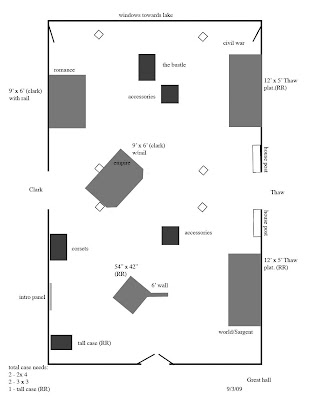
When I first started at Fenimore Art Museum we would lay our exhibits out on graph paper. A scaled outline of the gallery would be laid out and we would painstakingly make little cutouts of paintings, sculptures, and exhibit cases. Then we would slide them around our floor plan until we got them where we wanted them. Little dabs of glue stick would hold them in place until some poor soul accidentally gave the page a good knock. Then your gallery got “redesigned” and you spent time muttering under your breath while you tried to get it back in order.
You can imagine our delight when we found the beauty of designing in a graphics program. Yes, you still had to make a floor plan and size stuff, but no one could knock the darn thing off the table and scatter little pieces of paper to the wind. You could even create multiple versions of a layout and email them to your colleagues! Ya-hoo, we were talking progress.
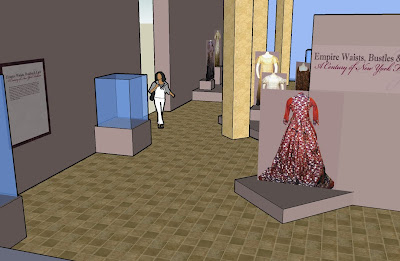
At this point many of you are nodding your heads and saying oh yes its Sketch-up (from Google). You would be right. For someone who started out way back using little cutouts to do floor plans this is indeed and amazing program. It is fairly intuitive to use. I find myself gaining skill as I go along. It does not do every single thing I would like it to, but it is a wonderful tool for giving you a fairly accurate feeling for how a gallery will look upon completion.
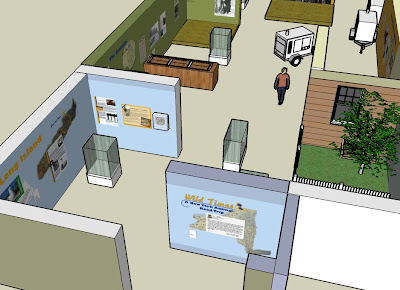
You can imagine our delight when we found the beauty of designing in a graphics program. Yes, you still had to make a floor plan and size stuff, but no one could knock the darn thing off the table and scatter little pieces of paper to the wind. You could even create multiple versions of a layout and email them to your colleagues! Ya-hoo, we were talking progress.So, imagine the delight and disbelief when we stumbled across a 3-D design program that was actually user friendly. This baby could help you lay out a gallery in 3-dimension, color the walls, chose floor treatments, place paintings and allow for 3-d views that made you feel like you were walking through a dollhouse. And (are you sitting down?), it was free.
At this point many of you are nodding your heads and saying oh yes its Sketch-up (from Google). You would be right. For someone who started out way back using little cutouts to do floor plans this is indeed and amazing program. It is fairly intuitive to use. I find myself gaining skill as I go along. It does not do every single thing I would like it to, but it is a wonderful tool for giving you a fairly accurate feeling for how a gallery will look upon completion.I used the program last year to good effect in laying out America’s Rome and the overall graphic treatments in the gallery. It was invaluable for figuring out how many animal-related objects could fit in the main barn for the Wild Times exhibit, and how the colors and graphics would relate to each other as you moved through regions. This year I have been laying out platforms for dresses for next year’s Empire Waists, Bustles and Lace exhibit.
My next trick will be to learn how to interface google earth and sketch-up. The possibilities seem endless and as the technology evolves there will always be another exciting opportunity to do it better.
Subscribe to:
Posts (Atom)