Showing posts with label Paul D'Ambrosio. Show all posts

Tuesday, December 6, 2011

You can make a difference

By Dr. Paul S. D'Ambrosio, President and CEO

Edward Hopper once said, “All I want to do is paint light on a side of building.” Sounds simple, right? But his ability to capture light is transformative. Ugly freight cars are beautiful; the working dock yard dynamic.


That is the power of art. It makes you think about things in different ways. It tells a story that brings a community together and speaks uniquely to the individual. If you value having that resource here in your community, then please make a donation today to support the Fenimore Art Museum.

Simply put, your investment in us will make a difference. $20 could pay for the fixtures to hang your favorite painting. $50 would underwrite planting our Three Sisters Garden in Otsego: A Meeting Place. With $100, we can update the Art Carts, allowing visitors to touch the materials used to create the art they see. $250 pays for supplies to paint one gallery wall for our upcoming American Impressionism: Paintings of Light and Life exhibition. $500 covers the cost of printing all the informational labels for next year’s exhibition Artist and Visionary: William Matthew Prior Revealed.

This just skims the surface of how your dollars will make a concrete and visible difference. We are working hard to keep the same level of excellence you have come to expect. But to continue, we need your help. We depend on the financial support of friends like you. We value your involvement in our museum. Thank you. But by doing a little bit more, by making a donation, you will make a difference today.

We offer three easy, safe, and convenient avenues for you to make a donation.
Contribute online: fenimoreartmuseum.org/donate
Contribute by phone: 607-547-1433
Contribute by mail: PO Box 800, Cooperstown, NY 13326

Thank you.

Thursday, May 13, 2010

QR codes - connecting galleries to blogs

By Michelle Murdock, Curator of Exhibitions

Are you thinking, “What is this?!” Or maybe you’re thinking, “Wait, where’s my phone?!” Yep, I said phone. For many smartphone users, this funny looking box is a gateway to new learning opportunities. Does that sound too stodgy? How about this – if you have an iPhone or Blackberry or Android, you know that this code can direct you to the coolest stuff you never knew about, and that these codes can be found anywhere from water towers to magazines to cupcakes to museum galleries.


They’re called QR codes – as in quick response. They’re two-dimensional codes that are very similar to barcodes. They can look slightly different depending on the company that created them. The phone applications are varied, too, but the vast majority are free. What does this have to do with our museums? As you can see in the picture above, we are using QR codes in our galleries this year. But let’s back up a sec. Remember our sister blog, American Folk Art @ Cooperstown, run by our VP & Chief Curator Paul D’Ambrosio? Last fall, the Exhibitions team at Fenimore dreamed of bringing our social media efforts into our galleries. We knew that we could run a poll on Paul’s blog, asking readers to vote for their favorite posts and we could then install the artifacts that the posts addressed. But that was kind of boring. Not very innovative. Thankfully, two fellow staff members, Kajsa Sabatke and Erin Crissman, suggested we use QR codes. We jumped on the opportunity to allow our onsite visitors to participate in our online conversations.

Each artifact in the exhibition is accompanied by the original blog post, the original comments associated with that post, and the QR code that directs users to the post itself. We’re encouraging on site visitors to use the codes to link to the comments section and leave their own thoughts about the artifacts and the exhibition.

We also have plans to incorporate more QR codes throughout the museum. The exhibition Watermark: Michele Harvey & Glimmerglass includes a code that links to Michele’s website. The exhibition In Our Time: The World as Seen by Magnum Photographers includes a code for The George Eastman House and Magnum Photographers.

Why are we doing this? Just for fun? Well, sure it’s fun, but of course there’s more to it than that. We believe in giving our visitors every opportunity – whether traditional, innovative, or downright wacky – to use, explore and engage with our collections in ways that they find appropriate and satisfying. What do you think? Let us know!

Wednesday, October 14, 2009

A 17th Century Calling Card

By: Paul D’Ambrosio, Vice President and Chief Curator, and Eva Fognell, Curator of the Eugene and Clare Thaw Collection of American Indian Art
It is probably one of the 17th-century’s most feared calling cards. An object, not a piece of paper, carrying a visage, not a name. It is also exceedingly rare; only one or two others are known to exist anywhere in the world.
Why refer to the club as a “calling card?” The 17th century Captain William Hyde explains, speaking of the Iroquois: “Now When These Men Goe a Scalping in Canada, they scratch the markes they have on their faces and bodyes upon their Clubhamers which they always leave behind them with the dead body, that it might be Knowne who did the action.” It was also a powerful statement to leave your war club next to your slain enemy’s body on the battlefield.
War clubs were often inscribed with personalized information and messages. On this club the self portrait features the owner’s tattooed face; a rayed sun motif at his mouth, a straight line and a dotted line running diagonally across his face, and a zigzag line arcing over his left eye. The small notch in his ear indicated that there may have been a feather or down decoration there. The self portrait is linked through a “power line” with an image of a turtle, the owner’s guardian spirit, on the other side of the club.. Warriors also ornamented their bags, spoons, bowls and other personal items with their particular guardian spirit. Also present on this club are markings illustrating the owner’s war records, or records of his war exploits; two slain enemies are visible under the turtle. A wolf with his tongue lolling out adorn the end of the club, its eyes were likely once inlaid with shell.

As a product of one of the New England coastal Native American groups in the mid-17th century, it is likely that this piece was used during King Philip’s War in 1675-76. Family records state that it was captured by Lieutenant John King in 1676 in a battle near Hatfield, Massachusetts. King helped lead the colonists and their Indian allies against the followers of the Indian leader Metacom, known to the English as “King Philip.” The war was particularly bloody for the time period in the American colonies; more than half of New England’s 90 towns were attacked by Metacom’s followers, including Plimouth Plantation itself, and more than 800 colonists and 3,000 Natives lost their lives. The Natives lost the war, and Metacom’s head was reportedly displayed at Plimouth Plantation for 20 years. Don’t count on seeing it there today.

The club remained in the King family for more than 300 years. One of the owners, Timothy Dwight (President of Yale College and an important writer of travelogues through the early Republic), wrote of the club in 1821, “I had one of these [war clubs] in my possession many years; in shape not unlike a Turkish sabre….On it were formed several figures of men….Some of them were standing; some of them were prostrated; and a few had lost their heads.”

Every time we see this club, we think of the recreated 17th-century objects and buildings at places like Plimouth Plantation and how rare a treat it is to see and experience anything surviving from the 1600s. This war club stands as a vivid reminder of the sometimes violent clash of cultures that accompanied the expansion of colonial settlements into Native territory. The club’s turbulent history, however, stands in marked contrast to its serene and elegant artistry, a testament to the proud and vibrant culture from which it came.
Photography by Richard Walker.

Wednesday, September 23, 2009

J.O.J. Frost’s Fifty Cent Paintings in a Wheelbarrow

By: Paul D'Ambrosio, Vice President and Chief Curator
The following post is from my other blog, American Folk Art at Cooperstown. Enjoy!

To say that you find folk art in the most unexpected places can be, in some circumstances, an understatement. Consider the case of John Orne Johnson (J. O. J.) Frost of Marblehead, Massachusetts. Frost was born in Marblehead in 1852 and went to sea as a young man, then settled down, married, had two children, and went into the restaurant business with his father-in-law. He retired due to illness in 1865 and helped his wife Annie raise her acclaimed sweet peas and flowers. After Annie’s death in 1919 he lived a quiet, solitary existence.
To fill his days, and perhaps overcome his grief, Frost took up painting. He depicted vivid scenes of Marblehead’s history, memories of his own life, and wooden models of ship, buildings, birds, and fish. Local legend has it that he often carted his paintings around town in a wheelbarrow, offering them for fifty cents each.

Eventually he was inspired to open his own museum at his home on Pond Street, where he built a small structure in the back and charged 25 cents to see his works and hear his stories of old Marblehead. Stories abound about how local folks made fun of the paintings, but did not deter Frost from his enterprise.

Frost died in 1928, and his son Frank inherited about 80 paintings. He sold some to a couple who arranged for a show at the Institute of Contemporary Art in Boston, which marked Frost’s first recognition as an artist, however short-lived.
The drama really unfolded in 1952, when a Mr. and Mrs. Mason bought the old Frost home on Pond Street. One day, while doing renovations to the house, they turned over some wallboards and found that the insides were painted with colorful scenes. By the time they finished their work, the Masons had discovered 33 Frost paintings that had been used by the artist's son to “sheetrock” rooms! The Masons sent the paintings off to galleries in New York and Boston in 1954, and Frost’s reputation as a major early 20th-century folk artist was sealed. Today his works are in major museums around the country.
You can see an impressive collection of Frost’s work at the Marblehead Historical Society and we always have one on view at the Fenimore Art Museum (see "Colonel Glover's Fishermen Leaving Marble Head for Cambridge, 1775" above). To me, it is another reminder to pay attention to those passionate local people who paint or sculpt their lives. And don’t ever pass up a fifty-cent painting in a wheelbarrow.
Above: Colonel Glover's Fishermen Leaving Marble Head for Cambridge, 1775 , painted in about 1925. Gift of Stephen C. Clark, N0024.1961

Wednesday, September 16, 2009

Headless Bodies: Myth or Fiction?

By: Paul D'Ambrosio, Vice President and Chief Curator

The following post is from my other blog, American Folk Art at Cooperstown. Enjoy!

In the more than 25 years of doing folk art exhibitions and giving tours to the public, I can attest that there is one “fact” that nearly everyone believes about folk art: folk portrait painters in the early and mid- 1800s painted the bodies in the winter and traveled around in the summer offering to paint one’s head in a body of one’s choosing. In fact, every time I take a tour group through the folk art galleries there is someone who will say, “Oh, those are the portraits where they painted the bodies in the winter…” How this iron-clad association came to be, I have no idea. It has not appeared in any published sources that I know of, even the popular magazines or newspapers that write about folk art.
So it will probably come as no surprise to you that it is patently untrue. Not that I can prove it to be false, but it stands to reason that if this was a wide-spread practice we would have found some headless bodies by now. Maybe stored away in some attic. Or in an artist’s estate. Or a little New England historical society collection (they save everything). Or at least written about in some diary or newspaper account from the 1830s or 1840s. But there is nothing. Dead silence on this issue.

What we do have, by contrast, is heads without bodies. Doesn’t that make more sense? People were particular about their likenesses. Before photography was invented in 1839 the portrait you had painted may well have been the only likeness of you taken in your lifetime. Often, artists would start with the head, sometimes on the back

of a canvas to practice. Sometimes, the picture is left unfinished for some unknown reason, and the head is left to float forever on the blank canvas. It would be pretty inconvenient – and an inefficient way of doing business – to travel the highways and byways with a load of headless bodies on canvas, hoping that you can somehow sell them all on your travels.
I suspect that the reason this myth came to be is the simple visual fact that many folk portraitists utilized stock poses and backgrounds to speed production of their work. The portraits shown here, by Samuel Miller, illustrate this practice. There is a certain sameness to how people presented themselves, and how they dressed, and how their interiors looked, that made this way of doing portraiture acceptable in many circumstances. But that’s still a far cry from peddling headless bodies.
Top: Picking Flowers, ca. 1845. Attributed to Samuel Miller (ca. 1807-1853). Gift of Stephen C. Clark, N0255.1961.
Bottom: Emily Moulton, by Samuel Miller, 1852, courtesy Currier Museum of Art, Manchester, NH

Tuesday, September 8, 2009

Folk Art on the Way to Anywhere

By: Paul D'Ambrosio, Vice President and Chief Curator
The following post is from my new blog - American Folk Art at Cooperstown. Enjoy!

The most remarkable thing about folk art is that it can be found anywhere. Perhaps the most exciting place to find folk art is along the highways or back roads of any region in the country. There are numerous folk artists who do more than make art; they create experiences by transforming their property into artistic environments that can be explored on foot.
These roadside attractions have been around for decades, but they have received a great deal of attention in the past 20 years or so. The most famous example is Watts Towers in Los Angeles (above), created by Simon Rodia from the 1920s to the 1950s and now a National Historic Landmark. Rodia was an Italian immigrant who spent 33 years making these 99-foot-tall towers out of steel pipes and rods coated with mortar and embedded with ceramic and glass.
Some of my favorite environments are in the South. Howard Finster’s Paradise Garden in Summerville, Georgia (above), was an amazing experience up until the mid 1990s, when I had the pleasure of visiting on several occasions. Finster was a Baptist preacher who believed he was instructed by God to "paint sacred art." The garden was one way he had of spreading the Gospel. Much of the best art from the garden is now in the collection of the High Museum of Art in Atlanta, a necessary step as exposure to the elements poses threats to many of these creations.
Another favorite folk environment is closer to home: Veronica Terrillion’s “Woman-Made” house and garden in Indian River, New York (above). I had the pleasure of meeting Mrs. Terrillion some years ago and getting a tour of her environment. It is a stunning collection of concrete figures that represent her life and her interest in nature. Veronica died in 2003, but her garden can still be seen from the roadside and can be visited by appointment. You can find out more here.

Why do these artists create these fantastic settings? Many are driven by an intense need to share some aspect of their lives, and for them, a picture or series of pictures isn't enough. They need to draw people into their world in a real, physical way. If you have ever been in one of these environments, you will quickly realize that being enveloped in some else's imagined and created world is an extremely effective way of understanding their life and its relation to your own. That really is the point of all art. It's just doubly impressive when someone with no prior aptitude in the arts is able to draw upon their manual skills gleaned from a lifetime of hard work to make something truly magical. I'll be featuring some stellar folk art environments in more detail in the weeks to come, so keep your eye out here and on the road. Do let me know if you see something I should be aware of.

After a visit to any one of the hundreds of these environments in the US, you will forever be on the lookout for great folk art on your journeys just about anywhere. It can make an ordinary trip the experience of a lifetime.

Tuesday, September 1, 2009

Need More Folk Art?

By: Paul D'Ambrosio PhD, Vice President and Chief Curator
Although I have been a contributor to the main Fenimore Art Museum blog for the past few months, it has always been in the back of my mind to devote an entire blog to a subject that has been my passion and my specialty for more than 25 years: American folk art. Recently, I decided to start a blog just for my graduate course in American folk art for the Cooperstown Graduate Program in Museum Studies. This seemed like a good way to foster communication among the students but also to share some of the interesting stories and experiences gleaned from 27 years of working with our renowned collection of American folk art.

Once I had this focus, the floodgates opened up. I immediately wrote down a list of about 50 blog posts that could be done without even doing research. And the stories were, shall we say, often quite colorful: folk masterpieces uncovered in the walls of a Marblehead, Massachusetts home; arcane allusions to Amazon warriors in a painting of a mermaid; portraits done by an artist while he was on the run from the law; and much more.

It occurred to me quite quickly that this blog might have broader interest than just the graduate students. And so my new blog, http://folkartcooperstown.blogspot.com/, was born. Please take a minute to check it out. You’ll get a new perspective on some artworks and artists you thought you knew, learn a lot of new things you hadn’t heard before, and gain a new appreciation of the creativity of ordinary men and women across the country. You might even have some great folk art stories to share. Either way, this blog will open your eyes to the art that is all around us.

Tuesday, August 25, 2009

Folk Art: It is what it is

By: Paul S. D'Ambrosio, PhD, Vice President and Chief Curator
Ah, the definition question. That has vexed folk art scholars for decades, mainly because the material is so varied and has attracted the attention of specialists with very different points of view ranging from community-based folklorists to aesthetically minded art historians. At Fenimore Art Museum, we generally take an art historical slant -- not surprising, I guess, since we are an art museum. The following is a working definition I developed for our permanent collection galleries about a decade ago. I'm hoping that some of my folklife colleagues will submit their own alternative perspectives here. For now, at least, here is what we use at the Fenimore Art Museum to guide our thinking about the folk art collection.

American Folk Art
At the end of the 19th century, a few collectors of Americana became interested in the aesthetic designs of redware, stoneware, glass and painted furniture produced in the colonial and federal eras. By the 1920s, proponents of avant-garde art admired a similar aesthetic between the painters and carvers of this period and the post-abstract art of the early twentieth century. In 1930, Holger Cahill, a curator at the Newark Museum, brought groups of 18th and 19th century American objects together for a ground-breaking exhibition entitled American Primitives. The visual power of the exhibition struck a chord in the American public and the basis for what is now termed American Folk Art was created. Cahill called folk art “the expression of the common people, made by them and intended for their use and enjoyment...It does not come out of an academic tradition passed on by schools, but out of a craft tradition plus the personal quality of the rare craftsman who was an artist.”
At about the same time, contemporary folk artists such as John Kane and William Edmondson achieved widespread acclaim at such prestigious institutions as the Carnegie Institute in Pittsburgh and the Museum of Modern Art in New York City. The interest in “modern primitives” grew in the 1940s, due largely to the efforts of dealer/author Sidney Janis and the phenomenal popularity of Grandma Moses. In the post-war decades American Folk Art has come to be recognized as a major contribution to American art and culture.

The artists and artisans who created these works are a disparate group. Historically, some folk artists acquired practical skills through apprenticeship in a craft tradition—such as sign painting or ship carving—and made their living by providing necessary items like portraits or shop signs. Others, particularly women, learned watercolor or needlework in schools and seminaries and created pictures for friends and relatives. A significant number of folk artists in the past and today acquired traditional skills through informal, intergenerational example. Lastly, there are folk artists, especially in this century, who create images that are highly personal through they may draw upon popular culture, memory, and the artist’s particular cultural or ethnic heritage. No matter how or why folk art is produced, it is valued for its beauty and expressive power, for the dynamic aesthetic of linear forms, strong colors, the combination of decorative and utilitarian concerns, and the sense of familiarity it evokes by reflecting everyday life as well as the hopes and dreams of ordinary people. Folk art is produced all over the world, and in every part of the United States. It is the product of people from many different backgrounds, creating art for many different reasons. This exhibition focuses on five major impulses in the creation of folk art:


· Expression of religious beliefs and values
· Decoration for the home
· Documentation of self, family, place, and community
· Expression of patriotism and political beliefs
· Stimulation of commerce

These universal impulses cross cultural boundaries and exemplify basic values shared by many Americans. The sixty pieces in this exhibition relate to one or more of these themes, represent the collective cultural heritage of America, and reflect the contributions of many different people to the mosaic of American culture.

So, let us know how you think American Folk Art should be defined!

Above: American Memory: Recalling the Past in Folk Art, installed at Fenimore Art Museum

Tuesday, June 30, 2009

A Visit to Homer's Studio in Maine

By: Paul D'Ambrosio, Vice President and Chief Curator
All art is local. No matter how much you study a particular painting you never truly understand it until you have seen the spot it depicts. I recently traveled to Maine and took the opportunity to pay a visit to the Winslow Homer Studio in Prouts Neck.

It was fortunate that the director of the Studio Project, Dan O’Leary, was so generous with his time as to meet my wife Anna and me on a Saturday morning to show us the site, which is not yet open to the public. The studio was purchased by the Portland Museum of Art a few years ago and they have been carefully restoring it to the period in which it was inhabited by Homer, from the 1800s until his death in 1910. Dan O'Leary, Director of the Homer Studio Project and the new President of MWPAI, gave us a behind-the-scenes tour of the studio, still in the process of restoration and not yet open to the public.
I have been familiar with the Prouts Neck paintings for some time: there are great examples in the Memorial Art Gallery of the University of Rochester and the Clark Art Institute, among others. What I did not understand until visiting Prouts Neck was that many of the oft-published notions about Homer are not as simple as they seem.

Homer lived a private, isolated existence in Prouts Neck. Well, he did have his brother Charles’ house about 200 feet away, where he went for meals prepared by his sister Matty. Homer kept to himself and didn’t like visitors. True, he was not keen on people stopping by the studio unannounced after he had achieved fame, but he also made friends with a number of the local fisherfolk and included them in his paintings. He also had a sense of humor: when someone asked him where all the empty rum bottles in his studio came from, he replied that he didn’t know; he had never bought an empty rum bottle in his life.
Lastly, Homer is a faithful transcriber of nature. Yes and no; he was very accurate in his depictions of natural phenomena that he observed daily, but he also took artistic license by creating composites that altered or combined a variety of elements. Waves that occur at high tide and low tide are seen together; islands are left out of the background; a distant view of the rocky coast is combined with a close-up of the studio building. The results are hard to argue with; nobody captured raw nature like Winslow Homer, who lived on its doorstep for much of his life.
Cannon Rock, one of Homer's favorite spots, just about 100 yards from the studio.
As I mentioned above, the studio and grounds are not yet open to the public. The Portland Museum of Art hopes to complete the restoration in the next few years and open the site for visitation. In the meantime, the museum has a wonderful gallery of Homer’s work in its main building.

Tuesday, June 23, 2009

We love Otsego County!

By: Michelle Murdock, Curator of Exhibitions
Twelve years ago I moved from Maine to a small town just outside of Cooperstown. I was embraced by the local community and within a short period of time, came to feel like part of a larger, county-wide community. This was a completely new experience for me because Mainers rarely identify themselves by the county they live in. But here in upstate New York, I soon realized the importance (and pleasure!) of county affiliations.

This week at the Fenimore Art Museum and The Farmers’ Museum, we are showing our deep appreciation for our friends and neighbors in our county. Otsego County Appreciation Week began on Monday and continues through Sunday June 28th. We’ll be offering half off admissions and memberships for Otsego County residents, and we’re hosting lots of fun events. At the Fenimore Art Museum, art activities will be offered for kids every morning at 10:15 a.m., and a curator-led tour will be offered each weekday afternoon at 2:00 p.m. My tour will be on Wednesday June 24th and I’ll be giving an overview of all the exhibitions currently on view. My colleague Paul D’Ambrosio will lead a tour of America’ Rome on Monday and Thursday and Eva Fognell will lead a tour of the Thaw Collection on Tuesday and Friday. And at 11:00 a.m. each morning, visitors can experience a guided tour of the new Interpretive Trail and the Mohawk Bark House which are located on the shore of Otsego Lake behind the Fenimore Art Museum. Speaking of Otsego Lake, I want to encourage you to bring a picnic to enjoy on the grounds of Fenimore when you come. I, too, will be taking my lunch lakeside, enjoying one of Otsego County’s natural treasures, near its premiere cultural treasure that I’m lucky enough to call my home away from home.Thank you Otsego County!

Wednesday, May 20, 2009

America's Rome - Opening Saturday

By: Paul D'Ambrosio, Vice President and Chief Curator
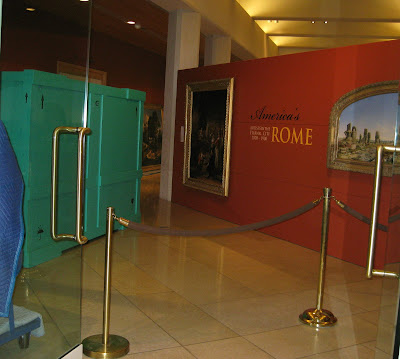
What a month it's been in Curatorial! After nearly two years of planning, more than 100 paintings have arrived on our doorstep to be uncrated and installed in time for Saturday's opening of America's Rome: Artists in the Eternal City, 1800-1900. The pieces look spectacular, especially when placed in their appropriate groupings and hung on the wall. The exhibition will take you through the Roman Forum, the Colosseum, and particularly the Campagna, or countryside. There are great Hudson River School style paintings by Thomas Cole, Albert Bierstadt, George Inness, Jasper Cropsey, and Sanford R. Gifford, among others. All of these painters traveled to Rome to improve their art, and the results showed in the fame they received upon returning and painting American landscapes in the same style. Come see for your self. The public opening is this Saturday, May 23, beginning at 10 am.


Tuesday, April 21, 2009

Rome Calling

by: Paul D'Ambrosio, Vice President and Chief Curator I spend a lot of time planning exhibitions; deciding which artworks tell a particular story, negotiating to bring those works together here at the museum, writing or editing labels, and working with the exhibitions staff to create a layout that brings the visitor into the world that the art portrays. My absolute favorite part of this job, however, is sharing that world with visitors after the exhibition is mounted. Over the course of the season I might give dozens of tours and lectures to hundreds of people. When we have exhibitions that are particularly popular, we simply schedule more and I make the time.

The problem is, even if I worked 24 hours a day, it would be impossible to reach more than a few hundred people this way. That is why we are currently exploring other forms of media to reach a far larger number of museum-goers. One of our new social media experiments this year will be cell phone tours of our new exhibition, America’s Rome. In the next few days I will be taping a tour of the exhibition (the paintings haven’t even arrived yet!) so that any visitor to the Fenimore Art Museum can dial in on their cell and listen to me while they tour the exhibition at their own pace. This way, I could reach thousands with the exhibition content that I’ve spent the last two years developing.

Importantly, the cell phone tour will include a feature allowing visitors to leave comments. This is very exciting and unprecedented here. Over the course of the year we plan to find ways to share these remarks with everyone, thus creating a shared product that I alone could not create.
If you get the chance this year, please give the cell phone tour a try and let us know what you are thinking about the topic of the meaning of Rome to America. Together we can make something worth more than the sum of its parts.
Worthington Whittredge. Aqueducts of the Campagna, 1859, Oil on canvas, 33 by 53 ¾ inches, Cincinnati Art Museum, Gift of Caroline Hooper, 1900.1

Tuesday, March 31, 2009

American Treasures: Installation

By: Paul D'Ambrosio, Vice President and Chief Curator
Life is good when business travel takes you to Palm Beach in February. That’s exactly what happened a few years ago when we sent an exhibition of the Fenimore’s permanent collection to the Society of the Four Arts. It was a big hit at the height of the winter cultural season; there were three nights of gala events with live music and dancing under a big tent on their lawn. The Society members were enthralled with our art collection – our Hudson River School landscapes and great folk art – and were equally entranced by the ocean breeze and 80 degree weather.

When we saw an opportunity in this year’s spring exhibition schedule, we thought it would be fun to bring many of these great artworks back together for a reunion. The result is the American Treasures exhibition, opening in the Fenimore’s Great Hall on April 1st. You’ll find some old friends along with some surprises, together in one gallery for the first time since the showing in Palm Beach.

Seeing these works together again – especially with the February snow blowing on the other side of the Great Hall window – brings back thoughts of a brief sojourn in a tropical paradise. And seeing how much the works were admired by a new audience recalls the continuing process of rediscovery that we hope to offer to all of you in the spring.

Right: Assistant Curator of Exhibitions Nisha Bansil installing Benjamin West’s portrait of Robert Fulton in American Treasures in the Fenimore Art Museum’s Great Hall.

Left: Laying out the title panel, featuring George Durrie’s Cider Making in the Country.

Thursday, March 19, 2009

Bear and Pears Fireboard

By: Paul D'Ambrosio, Vice-President and Chief Curator
Can a simple board and batten construction, meant to cover a fireplace in the summer months and painted with the edges of a rag or even a sponge, be considered an icon of American art? The Fenimore Art Museum’s Bear and Pears fireboard is just such a piece. In the past 150+ years this work has gone from gracing the parlor of a rural home in New Hampshire to the more auspicious homes of a series of astute collectors that included a famous modernist sculptor (Elie Nadelman) and a pioneering scholar/author (Jean Lipman) to its current museum setting.
Why is this fireboard considered a great work of art? The unknown artist who painted the picture followed the guidelines of tastemaker Rufus Porter, who published a book in the 1820s (titled Curious Arts) and a series of articles in Scientific American in the 1840s on how to do mural painting and simple, effective decoration. Everything in Bear and Pears is on the horizon line, objects are made different sizes to give the illusion of depth, and the artist used a rag or sponge and stencils to paint faster. The result may be out of line with what we consider realism – the “pears” are larger than the house – but the balance of forms and colors is striking. It’s no wonder that so many of these untrained artists created works that bend the rules of realism; it requires a lot of training and experience to make a painting a “window” into the observed world. It is a testament to their innate artistic ability that the works these folk artists made were sought after by connoisseurs of modernism and eventually enshrined in museum collections.

Unknown Artist. Bears and Pears Fireboard, c.1825-1835. Fenimore Art Museum, Cooperstown, NY. Gift of Stephen C. Clark, N0044.1961

Tuesday, February 17, 2009

The Masterpieces of the Prado Museum with Google Earth

By: Paul D'Ambrosio, Vice President and Chief Curator
An exasperated technologist, speaking to a group of art museum professionals at a conference, once exclaimed, “when you speak about putting your images on the web, I can never tell whether you want them to look good or want them to look bad.” For more than a decade this has been a central contradiction of the approach to art on the web; we want to do the images justice, but don’t them to be so good that we inadvertently encourage piracy or leave people with the impression that a first-hand viewing is no longer necessary. The latter concern never made sense to me. Why would we print beautiful, full color images in books and magazines and not worry about the same reaction then? It has always occurred to me that the most reproduced works in the world (ie., the Mona Lisa, or, in the US, American Gothic) are also the most visited. Exposure creates artistic “celebrities” that draw hordes of admirers and create a retailer’s dream. Still, many art museums continue to have a schizophrenic approach to sharing their works electronically.
Now, a new partnership between Google Earth and El Museo Nacional Del Prado in Madrid has, I contend, laid this issue to rest. In a stunning new offering that speaks as many volumes about the emerging 3D web as it does about the virtues of public access to art, one can now “fly” through the Prado in Google Earth and access ultra-high resolution images of fourteen of the museum’s greatest masterpieces. You can view a promotional video of the project here:

No interpretive label could possibly express what one can now see in these works as one zooms in for a close up of Rogier van der Weyden’s Deposition, for example, and examine the agony and the pathos with which the artist rendered every face. Even if you have seen these works in person, you have never seen them like this. And you will want to go back and view them with new eyes after this experience. Here’s hoping more museums jump on this bandwagon. We will all be the richer for it.

Tuesday, February 3, 2009

Americana Week in New York

By: Paul D'Ambrosio, Vice President and Chief Curator
Winter in NYC has always been an intensely social and productive time. In the 19th century, Hudson River School painters used to spend the winter months in their New York studios completing works they sketched on their fair weather excursions through the Catskills or Adirondacks, in between attending parties, dances, exhibitions, and other social events.

This tradition continues every January in Manhattan with Americana Week, which I recently attended as I do every year. This week includes major auctions at Sotheby's and Christies, antiques shows such as the American Antiques show in lower Manhattan and the prestigious Winter Antiques Show at the Park Avenue Armory on the Upper East Side. It also includes a full round of get-togethers with fellow museum professionals, collectors, gallery owners, and auction house staff. It's a perfect time to share information about recent or upcoming projects and to forge collaborations and generate ideas that can prove valuable to the fulfillment of a project.

This year was a little more subdued than in past years, as one might expect. There were a lot of concerns about the economy and its effect on the market. Still, the range of material being offered for sale was remarkable; everything from weathervanes to medieval illuminated manuscripts to Northwest Coast Indian masks.

Of course, the great harvest of Americana week in New York is not the objects but the marketplace of ideas and collaborations. The booths at the Winter Show are stunning, but the chance meetings with friends and colleagues in the aisles are better. In less than an hour I was able to talk to an Indian art dealer about the upcoming national tour of the Thaw Collection, discuss the Fenimore's planned 2010 exhibition on John Singer Sargent with one of the premier gallery owners carrying his work, and encounter numerous pieces comparable to those in our collections.
All in all, it was quite a week despite the state of the economy. As one auction house executive put it, at one of the receptions when he came up to a group of us and - knowing what was on our minds - said simply "The glass is half full." Looking around at the gathering of bright, dedicated, engaged people, I couldn't help but agree.

Shield, c1860, Fenimore Art Museum, gift of Eugene V. and Clare E. Thaw Charitable Trust, T0048

Monday, January 12, 2009

What the Barley Fork Reaped…"Let’s Buy Thirteen"

By: Paul D'Ambrosio, Vice President & Chief Curator
When the New York State Historical Association Board Chairman and chief patron Stephen C. Clark hired Dr. Louis C. Jones in 1947 to lead the Association that he had brought to Cooperstown, the two of them made an unlikely team. Clark was a scion of the Singer Manufacturing Company fortune and a great collector of Post-Impressionist and Early Modern art, while Jones was an academic who was teaching English at the State College for Teachers in Albany. Jones initially did not want the job; his interests were local history and folklore. He was actually a member of a group that called itself The Society for Connoisseurship in Murder. It says a lot about Lou Jones’s personality that he was once quoted as saying “I personally like murders much better than riots. They have a kind of intimacy that the larger gatherings lack.”

Yet Jones and Clark made an effective team, with Clark providing resources and collections and Jones developing innovative educational programs and advocating for the folk arts on a national level.

Their foray into American folk art began shortly after Jones was hired, when he and his curator Janet MacFarlane were discussing a barley fork that was in The Farmers’ Museum collection. They both felt that the barley fork showed the creative side of rural folk, an appropriate adjunct to the story of folk life told at The Farmers’ Museum. It gave them the idea of mounting an exhibition of this and other hand tools that were noteworthy by virtue of their design.

Jones recalled that Mr. Clark was enthusiastic about their idea and showed an immediate understanding of what constituted American folk art. Before the tool exhibit could even be mounted, Clark asked Jones to meet him at the Riverdale estate of Elie Nadelman, the Polish-born modernist sculptor who had been collecting folk art since the 1920s. Nadelman had opened one of the first museums devoted to this material at his home. From a house overflowing with all kinds of folk art, Clark asked Jones to pick out twelve pieces for the museum. After reviewing Jones’ selections, Clark said “I agree with you on eleven of them; let’s buy thirteen.” Their choices, national in scope and of the highest quality, foresaw the future character of the NYSHA folk art collection now housed at the Fenimore Art Museum.

Friday, December 5, 2008

Tribute to An Eclectic Visionary

By: Paul D'Ambrosio, Vice President & Chief Curator
I was saddened to hear of the recent loss of folk art collector Dorothea Rabkin. She and her husband Leo built one of the most interesting and eclectic collections of American folk art assembled in the late 20th century, and it was my great privilege to know them and visit their home on a number of occasions to enjoy their company and see their amazing things. They became friends and benefactors of the Fenimore Art Museum, and we are very fortunate to have wonderful examples of the fruits of their endless scouring of the countryside in our permanent collection. It is so rare to meet someone with a vision so astute and yet so broad; a testament to the enduring cultural value of the arts that she and Leo championed.

One incident at the Rabkins’ home stands out for me. My wife Anna and I were visiting the Rabkins several years ago, and after admiring their new purchases for awhile they offered us some refreshments. Dorothea served the coffee, handing the cup first to Anna. She immediately handed the cup over to me, whereupon Dorothea’s eyes widened and a smile lit up her face. “A wife serving her husband is something you just don’t see anymore,” she said, clearly impressed. I pretended like it was a daily occurrence, of course, but it illustrated to me that beneath the surface of the Rabkins’ innovative and omnivorous collecting was a wonderfully solid and old-fashioned relationship. They truly reveled in making each other happy. I am reminded of this incident often when I think of Dorothea, an immigrant woman with a traditional outlook within the home and a far-reaching and complex cultural vision without.

You can read more about Dorthea Rabkin here.
Empire State Building by Gregorio Marzan. Gift of Dorthea and Leo Rabkin. N0104.1991
Blog Widget by LinkWithin