Showing posts with label Empire Waists ... Fashion. Show all posts

Wednesday, December 8, 2010

To Drive the Cold Winter Away

By Chris Rossi, Associate Curator of Exhibitions

The view from my house this morning.

It’s been snowing for three days straight out here in the snow belt, and my attempts to make it to work have been frustrated by whiteouts and squalls. My trusty steed, a 2004 Saturn Ion, is snugged into what part of the driveway I could manage. Looking down the snow-filled valley I think of the families who lived here before me, in particular the Swartwout sisters, Ann and Sarah.

These gals had a great sense of style and married into the well-to-do Green family of Hubbardsville and Utica. The Greens prospered at hop growing and banking. We are very fortunate to have some of Ann and Sarah’s costumes here on display at Fenimore Art Museum in our Empire Waists, Bustles and Lace: A Century of New York Fashion exhibition. In addition to the two lovely dresses shown we have more items tucked away in our collection.

While I am out trying to dig out the car in my high-tech winter boots, jacket and snow pants I can’t help but contrast it to what Ann and Sarah would have been wearing. During the 1890s ladies did not wear pants (nor did they shovel out vehicles!). Winter clothing for women included layers of flannel and wool petticoats piled under skirts. A warm jacket made of wool or fur would top that off, with hat and gloves to match, and perhaps a muffler tucked in around the neck and chest for good measure. Let’s not forget a muff to finish the picture – a warm fur roll to keep hands warm.

Plate from Peterson’s Magazine showing fashionable French Winter fashions for women in the USA
From Claremont College Digital Library

The trusty steed would be hitched to a cutter. Horse-drawn sleds were the way to get around during a central New York winter. Roads were often rolled flat to allow for passage. Thanks to a friend I now have a heated seat warmer that plugs into my car. Sara and Ann would have used ember-filled foot warmers and fur rugs to stay toasty during winter visits.

American Homestead in Winter by Currier and Ives
Fenimore Art Museum, Cooperstown, NY, N0036.1964

The romance of a horse drawn sleigh ride does have its allure. But, it’s not the easiest way to make the slog to Cooperstown. I’ll leave that to the Swartwout sisters and be content to use my car, once they get my road plowed out...


Tuesday, July 27, 2010

More in the Family

By Chris Rossi, Associate Curator of Exhibitions

Blogging is a bit like putting a message in a bottle and tossing it out into the vast ocean of social media. Sometimes, if you’re lucky, a note comes bobbing back. If you’re really lucky the note contains something wonderful.

In this case something wonderful did come back - in a message I received from a member of the Packard family. Mr. Packard had read my blog about his great-grandmother’s travel dress and quilt being displayed with other family treasures in our Empire Waists, Bustles and Lace: A Century of New York Fashion exhibition here at the Fenimore Art Museum.

The Connecting Threads section of the exhibition is a mini-family reunion. Displayed together for the first time, the four textiles in this section – a needlework, wedding dress, quilt and travel dress – were created or owned by 3 generations of Washburn/Sands/Packard women. Mr. Packard, inspired by what he read about the exhibit, dug through the family files and provided us with photos and stories about his family.


The images he sent include one of Catherine Odessa Sands, who owned the amazing crazy quilt and wore the lovely burgundy velvet travel dress. Catherine married Joseph E. Packard in 1882, which was part of the inspiration for the crazy quilt with those big CSP initials stenciled on it. Along with the images of Catherine is one of her father, Dr. William G. Sands, who is characterized as someone who discharged his duties “with great fidelity and probity.”

Catherine Odessa Sands
Photo courtesy of Mr. Packard

Dr. William G. Sands
Photo courtesy of Mr. Packard

So, thank you Mr. Packard! This new information gives more depth to the family story and increases our understanding of the women who made and wore these wonderful textiles.

Thursday, July 1, 2010

Fashion and Philanthropy

By Chris Rossi, Associate Curator of Exhibitions

One of the highlights of our Empire Waists, Bustles and Lace: A Century of New York Fashion exhibition here at the Fenimore Art Museum is the pale green damask Worth gown owned by Miss Angelica Livingston Gerry. Mr. Worth, of Paris, was the “designer to the stars” of his day, with his dresses expertly pieced and fitted in sumptuous fabrics. His clothing was a “must have” for the rich and famous of the 1890s.


Angelica's Worth gown, photo by Richard Walker


Miss Angelica certainly was part of that crowd. Descended from New York’s and New England’s finest, the Gerry line went back to a signer of the Declaration of Independence, whose name is now infamously linked to the term gerrymandering. Her mother’s Livingston family was one of the best known and affluent in New York.

Angelica’s father, Elbridge T. Gerry, was a successful New York lawyer and active philanthropist. The president of the American Society for the Prevention of Cruelty to Animals (ASPCA), Mr. Gerry expanded his legal attention from protecting animals to protecting children. In 1877 he intervened in the landmark case of abused child “Mary Ellen.” The incident inspired the creation of the United States’ first child welfare group - The New York Society for the Prevention of Cruelty to Children, of which he was president.


Elbridge T. Gerry, photo courtesy of New York Society for the Prevention of Cruelty to Children


Her father’s good works must have inspired Angelica. Much of the family’s time was spent on their large estate on Lake Delaware near Delhi, New York. Angelica did not marry, but instead mentored and encouraged the youth of the area. In 1963, SUNY Delhi honored Miss Gerry by naming a dormitory in her honor for her help “to many young men and women in attending the agricultural and home economics studies in the early years of Delhi.”


Gerry Hall at SUNY Delhi

Tuesday, May 25, 2010

Buried in Albany, Remembered in Cooperstown

By John Hart, Assistant Curator of Collections

Probably one of the best aspects of being an historian is sharing information with others, or learning something new from a fellow researcher. And in this position I’m always receiving and giving out the history of an object, a person, or even an event.

Most recently I’ve been researching T. Ellery Lord, a Brevet Brigadier General from New York, as we included part of his uniform in Empire Waists, Bustles & Lace: A Century of New York Fashion. We are fortunate enough to have not one, but nearly three complete uniforms (along with patches, epaulettes and the like) that once belonged to Ellery, as he often called himself in his letters, in the collection, along with much of his correspondence during the Civil War in the NYSHA Research Library.

Imagine, then, my surprise when I came across a website that listed a T. Ellery Lord as being buried in Albany Rural Cemetery! A little digging here, a few emails there, and I stumbled upon Mark Bodnar, a Civil War historian from Albany who is quite familiar with the cemetery. After corresponding with Mark a few times, he was gracious enough to send me the images you see here (above and below), along with a reference to Ellery in a book written in the late 1990s, Brevet Brigadier Generals in Blue.


I was surprised yet again when I found that this book included an image of Ellery in uniform, and so far as I can tell, in the uniform we’re exhibiting at Fenimore! (below) The image and present-day representation isn’t exact, in fact. As one of the Cooperstown Graduate Program students, Andrew Gaerte, suggested, it’s likely that Ellery placed the epaulettes on his uniform sometime after the war since they’re a little impractical in battle (and would have made him an easier target, I imagine). But, we have the shoulder boards, as they’re called, that show the same rank that you see in the image.


For any historian interested in the Civil War, finding uniforms as intact, complete, and in such good condition as Ellery’s is a dream come true, but the connection made with another historian familiar with Ellery is even better.

Thursday, March 25, 2010

Bird's Eye View

By: Stephen Loughman, Preparator
While working on the lighting for the new exhibit, Empire Waists, Bustles and Lace: A Century of New York Fashion, I took the opportunity to snap a few “eye in the sky” photos. Lighting an exhibition is one of the very last steps before an opening, and can be a bit nerve wracking. Because of the height of the ceiling in the Great Hall here at the Fenimore, the only real way to access the lights is by using a Genie lift. Even though it can be a bit scary at times, it is a crucial step in mounting exhibitions, and a lot of fun, too.

Tuesday, March 23, 2010

Trim, Stuff, Wrap, Steam

By: Chris Rossi, Associate Curator of Exhibitions
I'm not sure what it is like in other work places, but I am always amazed at the number of hidden talents my coworkers seem to possess. Empire Waists, Bustles and Lace: A Century of New York Fashion, our soon-to-open fashion exhibition, has brought to the surface the previously untapped skills of my colleagues

I wasn't too surprised when Michelle Murdock, Curator of Exhibitions, revealed herself to be adept at fashioning petticoats out of tulle and wire. And I was pleased when Steve Loughman, our new Preparator didn't even bat an eye at my request for him to trim the base of one of our manikins and then give it hips and a bigger bottom.
What did take me by surprise was the ability of Ginny Reynolds and Brooke Steinhauser, our Cooperstown Graduate Program volunteers, to adeptly stuff 3 corsets into just the right shapes. Now we have 3 curvaceous corsets to demonstrate the different female silhouettes of the 19th century. I am sure this skill can be worked into their resumes ... somehow.
That should have prepared me for John Hart, our Assistant Curator of Collections, demonstrating that he knew exactly how to wrap our civil war general's sash and sword to military perfection. Where did he learn to do that?!
To top it all off Curator Erin Crissman from our sister museum, The Farmers' Museum just happened to mention that she had, once upon a time, spent a long summer vacuuming and steaming costumes. A week later she was hard at it in the gallery, giving tutorials on how to vacuum a costume without sucking up buttons and lace. Then it was on to steaming out the wrinkles from dresses that had spent the last 100 years in someone’s attic and then neatly tucked away in our storage facility.
The results of this sudden revelation of amazing and somewhat obscure talents-a delightful exhibit well trimmed, stuffed, wrapped and steamed-ready for our April 1 opening date. My thanks to my talented colleagues for making it happen!

Tuesday, February 2, 2010

Scandal Behind the Image

By: Chris Rossi, Associate Curator of Exhibitions

Many older pieces of folk art are created on material that might not normally be called “archivally approved”. Some of these same materials are used to back works of art as well. So it shouldn’t have been surprising to find that our lovely needlework picture created by Sally S. Washburn in January of 1808 was backed and sewn to an 1807 edition of the Otsego Herald.

What did come as a revelation were two little advertisements listed in that paper. I have this crazy idea that bad public behavior is a phenomenon of the modern age. I stand corrected. What we have in the 1807 Otsego Herald, from Oxford New York is the public airing of a private spat. Move over Tiger and Elin, Jenny and Mark Sanford, the Sills are hard at it in the press.

The October 30 advertisement, posted by Mr. Andrew Sills warns neighbors against harboring or trusting his wife, as he “shall pay no debts of her contracting.” Mrs. Parnell Sills takes it one step further in her advertisement. There she warns the public, more particularly all females “….against trusting him in any respect, for fear he will deceive and abase them, as he has the subscriber.” This after a preamble where in she gives hints at the numerous imprudences of her husband, including some that seem rather risqué for print in a public paper of the period. What happened with the Sills?! The advertisements leave one speculating on what went so terribly wrong that it would lead to dueling personal ads in an 1807 local newspaper. Then in contrast we have the needlework picture–a lovely depiction of domestic bliss with lovers courting against the backdrop of a charmingly rendered house and gardens. Who would ever imagine the intrigue and scandal that lurks hidden on the flip side of that innocent image.


Above: Needlework Picture by Sally S. Washburn, 1808, Fenimore Art Museum Collection along with Otsego Herald backing and close-up of articles.

Thursday, January 28, 2010

Making the Cut

By: Virginia Reynolds, CGP class of 2011

In the last ten years, reality TV has taken thousands of Americans behind the scenes. Whether it’s a jar of peanut butter or an evening gown, shows like How It’s Made and Project Runway show how much goes into a final product. Creating a museum exhibition is no different. Along with two other students from the Cooperstown Graduate Program (CGP), I have been working on the Fenimore’s upcoming exhibit, Empire Waists, Bustles & Lace: A Century of New York Fashion, which will open April 1, 2010.
My first official project was to locate prints in Godey’s Lady’s Book and Peterson’s Magazine, two nineteenth-century fashion magazines, to show changes in style over time. With over a hundred beautifully hand-colored images to choose from, selecting a few to accompany the exhibit’s labels was challenging. Next, I picked accessories for an 1830s dress and a men’s velvet suit from 1800. Even with a list of bonnets from the 1830s, it’s hard to not get distracted. Remember, the dress only needs one bonnet. The bonnets are stored in different boxes. Looking through and carefully unwrapping the acid-free tissue paper from the headwear feels like Christmas every time. While in storage or doing research, I am always surprised by what I discover.
Brooke Steinhauser and Jennie Davy also researched and recommended pieces for the exhibit. Brooke focused on undergarments – corsets, crinolines and bustle pads – all essential for creating iconic, nineteenth-century silhouettes. To put the dresses and people who wore them better into context, the some of the clothing will be displayed on antique furniture. Applying the information from her American Material Culture course, Jennie Davy selected a variety of furniture including chairs, mirrors, a sewing machine and reed organ.

From the time a museum picks an exhibit topic or theme, creating it takes hours of imaginative thinking, innovative research, careful selection, and meticulous design. Selecting what gets exhibited is only a small part of the process. Deciding what makes the cut is always difficult, but not everything can be displayed at once. Nevertheless, the design, materials, and intricate details of the items, which will be exhibited beginning in April, make the pieces absolutely incredible.
top: Godey's Plate, Fenimore Art Museum Collection.
bottom: 1890s hat worn by Catherine Odessa Sands Packard, Fenimore Art Museum Collection.

Thursday, January 7, 2010

All in the Family and soon to be All in the Exhibit

By: Chris Rossi, Associate Curator of Exhibitions

One of the best parts of doing an exhibit based on our own collections is the possibility of discovering or rediscovering something wonderful. I knew we had a fabulous clothing collection but was not aware how many family stories were woven throughout it.

We are fortunate in having Sue Friedlander working with us on the Empire Waists, Bustles and Lace exhibit for Fenimore Art Museum in 2010. Sue, a historian/museum consultant, knows the collections well so I should not have been surprised when she started linking objects and revealing a wonderful family story that goes back to a needlepoint, a wedding dress, a quilt, and a travel dress.

Our story begins with Sally Washburn, a resident of Oxford, NY, who, in 1808, stitches a lovely needlepoint of a country scene. A year later Sally marries Henry Mygatt and soon after gives birth to Sarah Eliza Mygatt.

Sarah grows-up and marries William G. Sands in 1837. For her wedding she wears a dress that becomes one of the stars of our collection. The Sands wedding dress is exquisite – white floral satin with numerous hand-stitched tucks and pleats. In addition to being in great shape and drop-dead gorgeous it is the earliest known example of a dress with a label in it (and we have it here in the NYSHA collection!).
The saga continues. In 1884 Catherine Odessa Sands Packard, daughter of William and Sarah makes a crazy quilt. In the quilt is a patch of fabric contributed by Catherine’s mother Sarah, and stitched with the dates 1837 and 1882. The fabric is from our very own Sands wedding dress (Sarah’s) and the dates commemorate Sarah and William’s 45th wedding anniversary (1837) and the 1882 wedding of their daughter Catherine.

One more piece from the family puzzle – a beautiful travel dress and jacket that was likely part of Catherine’s wardrobe. The burgundy velvet dress and matching jacket have molded glass buttons and are in stellar condition. The color and fabric resemble other patches on the quilt. Did Catherine work it in, as she had done with a patch from her mother’s wedding dress? It is hard for us to be certain. You will have an opportunity to decide for yourself when all 4 items go on display for the first time in 2010 as part of Empire Waists, Bustles & Lace.
Top: Needlework picture by Sally Washburn, 1808. Fenimore Art Museum Collection, Museum Purchase, N0161.1955
Center: Dress made by Warncock Fashionable Milliner, ca 1837. Silk, Fenimore Art Museum Collection, Gift of Mrs. Ruben Crispell, N0023.1962(01).

Bottom: Quilt by Catherine Odessa Sands Packard, ca 1882. Fenimore Art Museum Collection, Gift of Mrs. Ruben Crispell, N0022.1962.

Friday, December 18, 2009

"I saw it in the window …”

By: Chris Rossi, Associate Curator of Exhibitions
When I was a teen the days would be spent at school, then sports, then homework and finally some down time with the TV and chatting on the phone with friends. My best buddy Sheila and I would even watch TV together while on the phone. Our favorite show was Carol Burnett. Her spoofs on famous films and stars were legendary.

The crème de la crème for us was the Gone with the Wind routine. Carol as “Starlet O’Hara” tripping (literally) down the big staircase in her over-the-top southern bell dresses. The climax being a send-up of the famous scene from the original Gone with the Wind when a down but never beaten Scarlet makes a dress from the window curtains. Of course, in the Carol Burnett version the dress still has the curtain rod in it. A brilliant touch topped by her comment that she “saw it in the window and just couldn’t resist it!”
Carol Burnett as “Starlet O’Hara”
Dress, Fenimore Art Museum Collection

This little vignette has been tucked at the back of my mind since those halcyon days of endless phone chats with Sheila. So, I should not have been surprised when some of the dresses for our upcoming Empire Waists, Bustles and Lace exhibit brought it all back for me. We have one dress with such an accumulation of fringe and eye-popping colors that I could hear Miss Burnett’s dialogue as if it were yesterday. By the late 1870’s women were not just considered the light of the home, their dresses often resembled a decorative accessory for the home. With gathered drapes of fabric, tassels, and sculpted silhouettes, women’s fashion might have been worn, or, one could imagine it working equally well as household drapery or a throw for the couch. Wouldn’t “Starlet” be delighted!
Portrait of Miss Grady by Smith and Telfer, Fenimore Art Museum Collection

Godey's Fashions, Fenimore Art Museum Collection

Tuesday, December 1, 2009

Straight from the Heart of Hubbardsville

By: Chris Rossi, Associate Curator of Exhibitions
My friend lives in a 19th century farmhouse in the same lovely valley that my house inhabits. These grand old homes are left from the days when “Hops were King” and some farmers in Hubbardsville had the wealth to live like a central New York version of a minor monarch. The hops have come and gone and most of us live a much more modest lifestyle than the hop farmers before us. Many of the old farmhouses are now homes for those who work at schools, hospitals, and local businesses. And, as with my friend, the costume of choice for fall leisure time activity in Hubbardsville, is usually camo or Carharts rather than a fancy gown for a hop-pickers ball.
So, after catching her all tricked out for goose hunting – complete with pink/camo knitted gun cover - it was with some delight that I was able to send her images of our latest find for our upcoming fashion exhibit (Empire Waists, Bustles and Lace). The dresses, which were given to NYSHA by former Hubbardsvillians, the Green family, are opulent 19th century high fashion. It’s hard to reckon anyone in my town being able to wear dresses of this caliber anywhere ever! So it took a step back in time and a little research to see a different picture of sleepy little Hubbardsville that included the possibility of high fashion in the heart of rural New York.
In the mid-19th century Hubbardsville could boast a grist mill, saw mill, and cider mill, two stores, a meat market, a hotel, a wagon shop, two blacksmith’s shops, a cooper shop, and a shoe shop, as well as a boys academy and an opera house. Green Road, the big road in town, is named for Charles Green, a wealthy hops merchant and farmer, who built his large house on that road. It is this large Italianate house that we believe the dresses derive from. The women of the house attended fancy dress parties, including, it is rumored, the Astor Ball in New York City. Apparently hops money could even support buying gowns from Paris, as the label in one of the dresses attests. The hops money is gone and the little hamlet is living a more sedate lifestyle. The population numbered 123 in 1880. Today the population is about double but public buildings have been greatly reduced to a fire hall, old age home and a combo gas station/general store/post office fondly referred to as the Mall. The Hubbardsville Manor, our old folks home, is what was once the stately Green mansion. The view from my porch, however, remains essentially the same as it did in 1880. Looking down the valley I can make out the goose hunters waiting in the corn, and ahead, I can imagine the shadow of one of the Green girls in her velvet riding habit making her way before them through the autumn light.
Tuesday, October 13, 2009

Laying it out and making it all fit

By: Chris Rossi, Associate Curator of Exhibitions
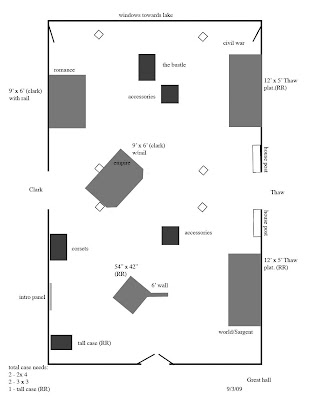
When I first started at Fenimore Art Museum we would lay our exhibits out on graph paper. A scaled outline of the gallery would be laid out and we would painstakingly make little cutouts of paintings, sculptures, and exhibit cases. Then we would slide them around our floor plan until we got them where we wanted them. Little dabs of glue stick would hold them in place until some poor soul accidentally gave the page a good knock. Then your gallery got “redesigned” and you spent time muttering under your breath while you tried to get it back in order.
You can imagine our delight when we found the beauty of designing in a graphics program. Yes, you still had to make a floor plan and size stuff, but no one could knock the darn thing off the table and scatter little pieces of paper to the wind. You could even create multiple versions of a layout and email them to your colleagues! Ya-hoo, we were talking progress.
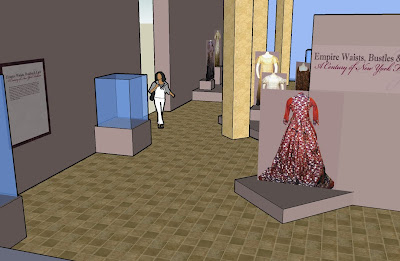
So, imagine the delight and disbelief when we stumbled across a 3-D design program that was actually user friendly. This baby could help you lay out a gallery in 3-dimension, color the walls, chose floor treatments, place paintings and allow for 3-d views that made you feel like you were walking through a dollhouse. And (are you sitting down?), it was free.
At this point many of you are nodding your heads and saying oh yes its Sketch-up (from Google). You would be right. For someone who started out way back using little cutouts to do floor plans this is indeed and amazing program. It is fairly intuitive to use. I find myself gaining skill as I go along. It does not do every single thing I would like it to, but it is a wonderful tool for giving you a fairly accurate feeling for how a gallery will look upon completion.
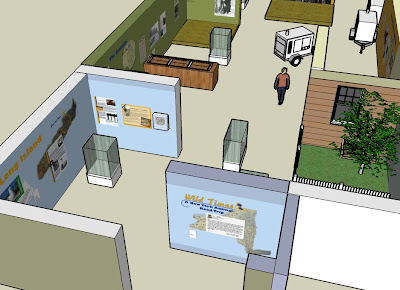
I used the program last year to good effect in laying out America’s Rome and the overall graphic treatments in the gallery. It was invaluable for figuring out how many animal-related objects could fit in the main barn for the Wild Times exhibit, and how the colors and graphics would relate to each other as you moved through regions. This year I have been laying out platforms for dresses for next year’s Empire Waists, Bustles and Lace exhibit.
My next trick will be to learn how to interface google earth and sketch-up. The possibilities seem endless and as the technology evolves there will always be another exciting opportunity to do it better.

Tuesday, September 22, 2009

What's in a name?

By: Chris Rossi, Associate Curator of Exhibitions
What’s in a name? Well, if you are titling an exhibit, there is a lot that goes in to finding just the right words. A couple of blogs ago we were talking about the upcoming fashion exhibit here at Fenimore Art Museum. We are featuring 19th century dress ranging from silk-shot empire waist gowns to the silky confections sported by women in John Singer Sargent portraits. The theme of the exhibit goes beyond the beauty of the clothes and talks about what was happening in New York State and our emerging American republic, and how all that influenced fashion in the 19th century.
A 3-D draft layout of the exhibition

So, how to convey some of that heavy stuff and still entice visitors in the front door and downstairs to the gallery? We started out with some very scholarly titles and quickly morphed into something a bit more playful.

From our first round we had - Connecting Threads: A Century of New York State Fashion – but there are ton of exhibits and publications using these words for textile shows, so we needed to dig a bit more.

And with a little help from other members of the curatorial team we got to - The Empire State’s New Clothes: 19th Century Upstate Fashion – which is nice but doesn’t roll off your tongue in quite the right way.

So, through our blog and Facebook post, we put it out to you, gentle readers, and we got some great responses. These included - New York State all Buttoned Up and Empire Waists in the Empire State – nice and catchy but its not all empire style clothing nor are we buttons only.
Close, very close, but with a little more work and this time help from our friends in our Marketing department we tweaked the empire waists and just starting rattling off clothing terms. Like Eliza Doolittle singing about that “Rain in Spain” we kept rolling words off our tongues, and “By George we got it”- Empire Waists, Bustles and Lace: A Century of New York Fashion. Yes, a bit light and playful, but we also hope memorable and enticing. Come to the Great Hall in Fenimore Art Museum next April and see what is really behind all that lace and finery. You may be surprised at what you learn and still have fun doing it!
Variations in the graphic treatments for the new title.

Thursday, July 30, 2009

Sorting out the Closet

By: Chris Rossi, Associate Curator of Collections

What is in your closet? At home I have the usual work and casual items as well as a few old items that perhaps, someday, I will wear again. I have been trying to keep to a 5-year plan, meaning if I don’t wear it at least once in five years off to the Goodwill box it goes.

In our closet, ours being the Fenimore Art Museum, we have articles of clothing that have not been worn in 200 years. My 5-year “use it-or-lose-it” rule does not apply. Here, age and infrequent use are assets and are criteria for keeping. The fun part is when the keeping/collecting becomes an opportunity for displaying.

My colleagues and I are enjoying the pleasure of sifting through the thousands of dresses, skirts, shirts, pants and undies that make up our clothing collection. The goal is to select great examples of 19th century upstate New York fashion for our 2010 exhibit season. Yes, we did have fashion up here in the 19th-century New York “wilderness”, and still do today! So far we have empire waist dresses sewn with silver thread, wedding dresses (not in white), civil war-inspired military-themed day dresses, as well as stunning silk ball gowns. And, there will be kids clothing and some men’s wear and most certainly corsets. (Then, as now, it’s often all about the undergarment!)The question is, what to title the exhibit? The theme is the influence of state and national events on 19th century New York State fashion.
Suggestions so far are:

Connecting Threads: A Century of New York State Fashion

The Empire State’s New Clothes: 19th Century Upstate Fashion


We would love your help. Do you have an idea for a title? If so, send it along as a comment on this blog. Thanks!

Photos above: Consultant Janet Rigby (blue shirt) and Associate Curator of Exhibitions, Chris Rossi (orange shirt) prepare dresses for photography

Blog Widget by LinkWithin