By John Hart, Assistant Curator of Collections
Having worked at the Fenimore Art Museum and The Farmers' Museum storage facility for over three years now, there isn’t too much that surprises me when I stumble across it on a shelf. Except for a box of dozens of cameos. And not the cameo pins like most people are familiar with; these are plaster, and used to be glued into the trays in which they’re still contained. I’ve questioned for a few months now “What exactly are these?” They’re not jewelry, but they’re so small they can’t possibly be art to hang on a wall, unless you live in a doll house.
Well, looking under the lid helps.
The label is in Italian, and I’ll be honest, I haven’t spoken a complete sentence in Italian in over 20 years. Thank you Google! Given the translation of the first few words I figured out that this is a sample box of a cameo artists work, and the artist’s name was Giovanni Liberotti. I butchered the translation, even online, of the rest of the label, but it appears that the artist gathered the likenesses of other cameos and recreated them, showing off his own talent. Sort of an early artist’s portfolio I suppose, to help the artist have more work.
For some reason it never occurred to me until today that something like this sample set would have ever existed, but it certainly brings up other questions that the historian in me wishes could be answered. Was this kit brought from Italy by the artist to find work in America? Did someone find it in a dusty shop somewhere in Rome and bring it back as a souvenir? Who was Giovanni Liberotti? (I found a few answers to that question thanks to Google again!) In any event, it’s a very nice set of sample pieces that I can’t wait to work with a little more!
Cameos, Givoanni Liberotti, Plaster, various sizes, N0146.1969.
Showing posts with label John Hart. Show all posts
Tuesday, November 1, 2011
Thursday, September 22, 2011
Cider time!
By John Hart, Assistant Curator of Collections
All around New York State, apple orchards are opening up for people to pick every conceivable variety of apple you could imagine. Whether you’re making an apple pie, drying them for a snack, or some other culinary concoction, apples in New York are a perfect fall treat.
Places like Middlefield Orchard or the Fly Creek Cider Mill are busy offering U-Pick apples or making enough cider to stock up and have enough for all next summer. It’s really nice to walk into the Fly Creek Cider Mill and grab a gallon of cider in July!
I still remember my first trip to an apple orchard when I was in either preschool or kindergarten and ever since I’ve been hooked. Whether I’m going to pick some of my favorites or just grab some cider or warm apple cider donuts, every fall I make it a point to make sure I find an orchard, farm stand, or mill, and stop in and support the local growers and sellers. I’m just glad making cider is easier today than it was around the time William M. Davis painted Cider Making On Long Island (seen above); I’m not sure I could be patient enough to wait ! !
All around New York State, apple orchards are opening up for people to pick every conceivable variety of apple you could imagine. Whether you’re making an apple pie, drying them for a snack, or some other culinary concoction, apples in New York are a perfect fall treat.
Places like Middlefield Orchard or the Fly Creek Cider Mill are busy offering U-Pick apples or making enough cider to stock up and have enough for all next summer. It’s really nice to walk into the Fly Creek Cider Mill and grab a gallon of cider in July!
Cider Making On Long Island, ca. 1870, by William M. Davis ( 1829- 1920),
Oil on Canvas, H: 17 1/8” x W: 27 ½”, N0368.1955.
I still remember my first trip to an apple orchard when I was in either preschool or kindergarten and ever since I’ve been hooked. Whether I’m going to pick some of my favorites or just grab some cider or warm apple cider donuts, every fall I make it a point to make sure I find an orchard, farm stand, or mill, and stop in and support the local growers and sellers. I’m just glad making cider is easier today than it was around the time William M. Davis painted Cider Making On Long Island (seen above); I’m not sure I could be patient enough to wait ! !
Friday, August 26, 2011
Firefighting in the 19th Century
By John Hart, Assistant Curator of Collections
Over the past several months, the curatorial staff has been busy moving things around in the basement of the storage facility to make way for upgrades to the ventilation system. While doing so, we’ve uncovered quite a few things, including the image below.
Having more or less grown up at the firehouse at which my father volunteered, I’m not a stranger to old fire apparatuses. I used to pull an early hose cart in my hometown parades and even got in trouble one day when I pumped the siren control on the old Mack fire engine and it came screaming to life, much to everyone’s shock and surprise (the siren hadn’t worked on the truck in years and somehow I figured out how to make it work).
For the 2007 season, Fenimore Art Museum had an exhibit titled Folk Art on Fire, which exhibited early fire fighting and fire-related folk art. It was a fascinating exhibit and one that I truly enjoyed. It was at that time that I was able to get my first good look at the fire pumper, Neptune, which our sister museum, The Farmers’ Museum, has in its collection. Dating between 1820 and 1830, this pumper, seen below, was the third pumper used by the Cooperstown fire department, which acquired it around 1841 after a devastating fire in the village. It remained faithfully in service until 1901.
You’ve probably seen old fire apparatuses in parades, rusting away quietly in a field, or in museums, but it’s nice to know that photographs of the men that used that old equipment survive today and show, in some pretty striking detail, what was used before today’s technologically advanced fire trucks.
Over the past several months, the curatorial staff has been busy moving things around in the basement of the storage facility to make way for upgrades to the ventilation system. While doing so, we’ve uncovered quite a few things, including the image below.
Oneonta Fire Company, ca. 1847-1855
Having more or less grown up at the firehouse at which my father volunteered, I’m not a stranger to old fire apparatuses. I used to pull an early hose cart in my hometown parades and even got in trouble one day when I pumped the siren control on the old Mack fire engine and it came screaming to life, much to everyone’s shock and surprise (the siren hadn’t worked on the truck in years and somehow I figured out how to make it work).
For the 2007 season, Fenimore Art Museum had an exhibit titled Folk Art on Fire, which exhibited early fire fighting and fire-related folk art. It was a fascinating exhibit and one that I truly enjoyed. It was at that time that I was able to get my first good look at the fire pumper, Neptune, which our sister museum, The Farmers’ Museum, has in its collection. Dating between 1820 and 1830, this pumper, seen below, was the third pumper used by the Cooperstown fire department, which acquired it around 1841 after a devastating fire in the village. It remained faithfully in service until 1901.
Old Neptune No. 3
You’ve probably seen old fire apparatuses in parades, rusting away quietly in a field, or in museums, but it’s nice to know that photographs of the men that used that old equipment survive today and show, in some pretty striking detail, what was used before today’s technologically advanced fire trucks.
Tuesday, July 26, 2011
Nature and The Smith-Telfer Photography Collection
By John Hart, Assistant Curator of Collections
I had a pleasant surprise during NYSHA’s Annual Meeting recently involving the work I used to do for Rights and Reproductions for Fenimore Art Museum and The Farmers’ Museum. David Stradling, author of The Nature of New York: An Environmental History of the Empire State, was the keynote presenter this year and discussed the examination of the idealized landscapes of the Hudson River School artists.
It was a fascinating presentation and before he even began, he took a moment to thank me for the images I provided him from the Smith-Telfer Photography Collection for his book! I would get thank you notes once in a while, but have never been thanked, let alone acknowledged, in a university professor’s presentation before. It was certainly unexpected, greatly appreciated, and a privilege to help him with his book project.
If you have an interest in environmental history, The Nature of New York: An Environmental History of the Empire State, is certainly a book you should consider reading. And since the weather is starting to cooperate (maybe I should knock on wood now…), go out and enjoy the nature that David writes about. There’s nothing like a nice hike up a mountain to see what the great artists of the Hudson River School admired so greatly.
I had a pleasant surprise during NYSHA’s Annual Meeting recently involving the work I used to do for Rights and Reproductions for Fenimore Art Museum and The Farmers’ Museum. David Stradling, author of The Nature of New York: An Environmental History of the Empire State, was the keynote presenter this year and discussed the examination of the idealized landscapes of the Hudson River School artists.
It was a fascinating presentation and before he even began, he took a moment to thank me for the images I provided him from the Smith-Telfer Photography Collection for his book! I would get thank you notes once in a while, but have never been thanked, let alone acknowledged, in a university professor’s presentation before. It was certainly unexpected, greatly appreciated, and a privilege to help him with his book project.
If you have an interest in environmental history, The Nature of New York: An Environmental History of the Empire State, is certainly a book you should consider reading. And since the weather is starting to cooperate (maybe I should knock on wood now…), go out and enjoy the nature that David writes about. There’s nothing like a nice hike up a mountain to see what the great artists of the Hudson River School admired so greatly.
Tuesday, July 5, 2011
Rain Rain, Go Away
By John Hart, Assistant Curator of Collections
Poestenkill, N.Y., 1862
Poestenkill, N.Y., painted in 1862 by Joseph Henry Hidley, shows a typical New York in the 19th century whose sight lines not only draw you to the village, but to the clouds above. It makes you stop and think, ‘Has the storm passed or is it just arriving?’
There is a painting in the Fenimore Art Museum collection that always makes me stop and think, and this even after a few years of Paul D’Ambrosio explaining the work to my class as a student with the Cooperstown Graduate Program.
Poestenkill, N.Y., 1862
by Joseph Henry Hidley (1830-1872)
Oil on wood panel, H: 19” x W: 31 ¼”, N0382.1955. Photograph by Richard Walker
Poestenkill, N.Y., painted in 1862 by Joseph Henry Hidley, shows a typical New York in the 19th century whose sight lines not only draw you to the village, but to the clouds above. It makes you stop and think, ‘Has the storm passed or is it just arriving?’
Given the weather we’ve had in Cooperstown over the past few days (torrential downpours, thunder, lightning and streets flooding), I was reminded of this painting. We’ve had cloudscapes the past few days that definitely make you wonder, ‘How bad are we going to get hit this time?!’ Several years ago the area received such bad storms that several roads were washed out, a bridge was destroyed, and other significant damage. I hope to not experience that anytime soon, and rather focus on the peaceful calm of the village of Poestenkill.
Wednesday, May 25, 2011
When a Horse Isn't Just a Horse
By John Hart, Assistant Curator of Collections
I cant put my finger on it, but it seems like at every museum that I’ve ever interned, volunteered or worked (with the exception of a historic battlefield) something from China always appears. In my first experience it was ceramic jugs that had been turned into electric lights. A few years later at a different institution I ran into two statues, a horse and a camel, referred to as Sancai (pronounced sāncǎi), which were previously owned by an Asian art collector. Fast-forward three years and lo and behold, now it’s two other horses, one made into an electric lamp and the other left as a statue.
My first reaction was “Hey, I didn’t know we had any Sancai pieces in the collection!” That is, until I saw them. Sancai is a glazing technique, literally meaning “three colors,” using different elements that turn to yellow, green, and white when fired in a kiln. While the form is certainly correct (Sancai pieces tend to be horses or camels, and this prancing horse is a common theme), it’s pretty clear from the surface that these were never really glazed and the paint has certainly seen better days.
Could they be from the Tang Dynasty, which is when this art form was at its height? Certainly, but there’s no way to know for sure until an expert looks at them and compares them to other known pieces and styles of construction. In the meantime, they’ll remain safe and sound in storage for someone else to find and become interested in.
I cant put my finger on it, but it seems like at every museum that I’ve ever interned, volunteered or worked (with the exception of a historic battlefield) something from China always appears. In my first experience it was ceramic jugs that had been turned into electric lights. A few years later at a different institution I ran into two statues, a horse and a camel, referred to as Sancai (pronounced sāncǎi), which were previously owned by an Asian art collector. Fast-forward three years and lo and behold, now it’s two other horses, one made into an electric lamp and the other left as a statue.
My first reaction was “Hey, I didn’t know we had any Sancai pieces in the collection!” That is, until I saw them. Sancai is a glazing technique, literally meaning “three colors,” using different elements that turn to yellow, green, and white when fired in a kiln. While the form is certainly correct (Sancai pieces tend to be horses or camels, and this prancing horse is a common theme), it’s pretty clear from the surface that these were never really glazed and the paint has certainly seen better days.
Electric lamp, date unknown, earthenware, N0547.1948(01) #1
Statue, date unknown, earthenware, N0547.1948(02)
Could they be from the Tang Dynasty, which is when this art form was at its height? Certainly, but there’s no way to know for sure until an expert looks at them and compares them to other known pieces and styles of construction. In the meantime, they’ll remain safe and sound in storage for someone else to find and become interested in.
Monday, May 2, 2011
Reorganizing Photographic History
By John Hart, Assistant Curator of Collections
In other posts I’ve mentioned the thousands of glass plate negatives in the collection of the New York State Historical Association, but something exciting is happening to those plates once again - they’re being moved. Not off-site, but rather into a newly renovated space in our storage facility. We’re in the midst of a project that will give us heat, ventilation, humidity control and air conditioning control of the space; part of that is reshousing nearly 60,000 glass plate negatives. It’s a long and tedious project that requires us to be very careful as we move groups of plates from one shelving system to the next, not only because they are fragile, but we need to keep them in order to find them later.
As difficult as it is to move these plates, the project is coming along well. With the help of assistants like Elizabeth Nerland of the Cooperstown Graduate Program, and others, we’re making steady progress towards completing this phase of the project. It’s a worthwhile cause and will allow us to access the plates quickly and easier than before, as well as consolidate our storage space, freeing up desperately needed space for other objects.
It’s a win-win for access and preservation, even if it will take us a few weeks to move the plates and make all of the other necessary changes in our database.
In other posts I’ve mentioned the thousands of glass plate negatives in the collection of the New York State Historical Association, but something exciting is happening to those plates once again - they’re being moved. Not off-site, but rather into a newly renovated space in our storage facility. We’re in the midst of a project that will give us heat, ventilation, humidity control and air conditioning control of the space; part of that is reshousing nearly 60,000 glass plate negatives. It’s a long and tedious project that requires us to be very careful as we move groups of plates from one shelving system to the next, not only because they are fragile, but we need to keep them in order to find them later.
Current storage area for the plates is pretty tight and difficult to maneuver.
As difficult as it is to move these plates, the project is coming along well. With the help of assistants like Elizabeth Nerland of the Cooperstown Graduate Program, and others, we’re making steady progress towards completing this phase of the project. It’s a worthwhile cause and will allow us to access the plates quickly and easier than before, as well as consolidate our storage space, freeing up desperately needed space for other objects.
New storage area for the plates is open and more accessible.
It’s a win-win for access and preservation, even if it will take us a few weeks to move the plates and make all of the other necessary changes in our database.
Tuesday, April 12, 2011
Batter Up!
By John Hart, Assistant Curator of Collections
I’ve haven’t always been into sports. I didn’t start watching baseball games until college (and no, I’m not saying which team I like the most) and even then it was in between homework sessions; being a history major meant a lot of reading.
Opening Day in Cooperstown doesn’t just mean the first MLB games of the year, it normally means the early days of spring and the start of warmer weather. I think Mother Nature had different ideas of that this year, though, since we were expecting upwards of a foot of snow or more between Opening Day and April 1st!
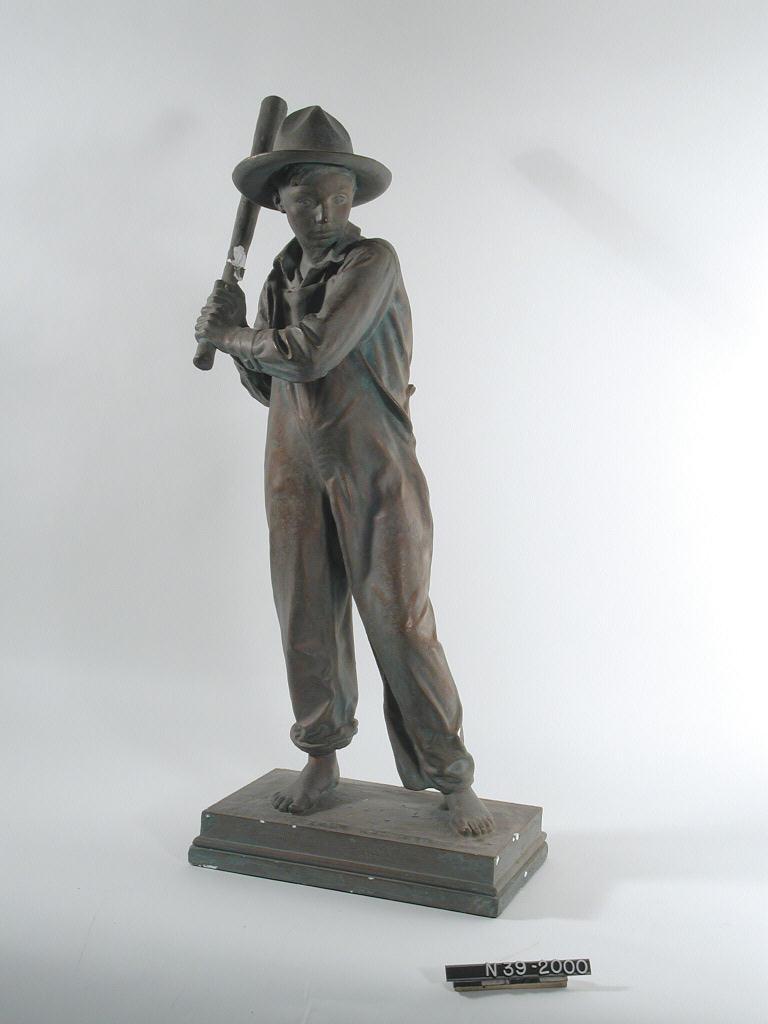
One of the more unique pieces in our collection related to baseball is the sculpture, Sandlot Kid, by Victor D. Salvatore. If you’ve ever been to Cooperstown and walked down Main Street near the Key Bank, you’ve seen this piece, only much larger and made of metal. NYSHA’s is plaster and is a model of the sculpture gracing downtown Cooperstown.
The National Baseball Hall of Fame and Museum, like Fenimore Art Museum and The Farmers’ Museum, really gear up around this time of year offering new exhibits, exciting new activities, and even better, the signal that summer is on its way! Eventually...
I’ve haven’t always been into sports. I didn’t start watching baseball games until college (and no, I’m not saying which team I like the most) and even then it was in between homework sessions; being a history major meant a lot of reading.
Opening Day in Cooperstown doesn’t just mean the first MLB games of the year, it normally means the early days of spring and the start of warmer weather. I think Mother Nature had different ideas of that this year, though, since we were expecting upwards of a foot of snow or more between Opening Day and April 1st!
Baseball Bat, Late 19th Century, Wood, L: 30 ¼”, F0031.1960.
One of the more unique pieces in our collection related to baseball is the sculpture, Sandlot Kid, by Victor D. Salvatore. If you’ve ever been to Cooperstown and walked down Main Street near the Key Bank, you’ve seen this piece, only much larger and made of metal. NYSHA’s is plaster and is a model of the sculpture gracing downtown Cooperstown.
Sandlot Kid, 1940-1950, by Victor D. Salvatore (1885-1965), Plaster,
H: 32 5/8” x W: 15” x Depth: 10 ½”. N0039.2000
The National Baseball Hall of Fame and Museum, like Fenimore Art Museum and The Farmers’ Museum, really gear up around this time of year offering new exhibits, exciting new activities, and even better, the signal that summer is on its way! Eventually...
Tuesday, March 29, 2011
A Violin’s Secret
By John Hart, Assistant Curator of Collections
There are a few decorated violins in our collection, one is currently out on exhibit at Fenimore Art Museum, the other has sat up on a shelf, out of sight and likely out of mind, for many years. This violin, though not as nice as the Tippecanoe example on exhibition in Bits of Home, is pretty striking on its own.
On its back is a small church created using marquetry and inlaid mother-of-pearl. It is surrounded by a decorative purfling, or decorative inlay found on the edge of most violins. This purfling is doubled, which is somewhat unusual to see, and has become an extra embellishment on the violin. Though no longer complete, you can see three different types of wood used for the church, and mother-of-pearl for the windows.
I’m not certain, but I don’t think the church decoration was originally on the violin, at least not at first. There are a few repairs at the scroll area of the violin and other repairs throughout. Was this violin repaired and then someone decided to use it as a decorative piece, rather than a playable instrument? Maybe, but we’ll never really know.
Violin and Neck, 1875-1925, Maple, pine, mother-of-pearl and inlaid other inlaid wood, N0978-979.1943.
There are a few decorated violins in our collection, one is currently out on exhibit at Fenimore Art Museum, the other has sat up on a shelf, out of sight and likely out of mind, for many years. This violin, though not as nice as the Tippecanoe example on exhibition in Bits of Home, is pretty striking on its own.
On its back is a small church created using marquetry and inlaid mother-of-pearl. It is surrounded by a decorative purfling, or decorative inlay found on the edge of most violins. This purfling is doubled, which is somewhat unusual to see, and has become an extra embellishment on the violin. Though no longer complete, you can see three different types of wood used for the church, and mother-of-pearl for the windows.
I’m not certain, but I don’t think the church decoration was originally on the violin, at least not at first. There are a few repairs at the scroll area of the violin and other repairs throughout. Was this violin repaired and then someone decided to use it as a decorative piece, rather than a playable instrument? Maybe, but we’ll never really know.
Violin and Neck, 1875-1925, Maple, pine, mother-of-pearl and inlaid other inlaid wood, N0978-979.1943.
Thursday, February 24, 2011
The John Kidder Civil War Collection
John Hart, Assistant Curator of Collections
Just before Thanksgiving of 2010, I had the good fortune to meet a descendant of the Civil War soldier, John Kidder, who mustered into service at the rank of Captain, and mustered out as a Lt. Colonel. The donor was bringing letters and other documents to the NYSHA Research Library to be considered as a gift. Because of the connection between Kidder and the 121st Regiment of the New York State Volunteers, a regiment I have been actively researching for well over two years now, I was interested in seeing the papers.
Much to my surprise, the donor brought something else - well, several things actually. In an old gift box were seven ribbons and a sash, all concerning Kidder’s post-war activities related to the encampments, remembrance days or dedications. These were all in absolutely fantastic condition; as you can see below, this particular one was probably still as bright as the day Kidder received it.
Combined with other objects in the collection that relate to the 121st, such as the swords of the Campbell brothers and the papers of Sam Kelley in the NYSHA Library, the ribbons and papers that have been donated the museum are amazingly valuable because we can now begin to understand more of the regiment during and after the Civil War.
Just before Thanksgiving of 2010, I had the good fortune to meet a descendant of the Civil War soldier, John Kidder, who mustered into service at the rank of Captain, and mustered out as a Lt. Colonel. The donor was bringing letters and other documents to the NYSHA Research Library to be considered as a gift. Because of the connection between Kidder and the 121st Regiment of the New York State Volunteers, a regiment I have been actively researching for well over two years now, I was interested in seeing the papers.
Much to my surprise, the donor brought something else - well, several things actually. In an old gift box were seven ribbons and a sash, all concerning Kidder’s post-war activities related to the encampments, remembrance days or dedications. These were all in absolutely fantastic condition; as you can see below, this particular one was probably still as bright as the day Kidder received it.
Ribbon, ca. 1892, Artist unknown, Silk, W: 2.5” x L: 10”, N0001.2011(06)
Combined with other objects in the collection that relate to the 121st, such as the swords of the Campbell brothers and the papers of Sam Kelley in the NYSHA Library, the ribbons and papers that have been donated the museum are amazingly valuable because we can now begin to understand more of the regiment during and after the Civil War.
Friday, February 4, 2011
Chinese Wall Gun in Central New York
By: John Hart, Assistant Curator of Collections
As I walked upstairs to the second level of Fenimore Art Museum's storage facility for the very first time, turning the corner the first words out of my mouth were something to the effect of “What the heck is that?” Resting against a shelving unit, reaching nearly 9’ in the air was something I had never once thought would be in the collection of a historical society in the middle of New York State, let alone in Cooperstown. That was the winter of 2006 when I interviewed as a candidate for the Cooperstown Graduate Program; the thing that astonished me: a Taiqiang, or in its anglicized spelling, a jingal, commonly called a Chinese Wall Gun.
Hearsay at the museum led me to believe the gun was probably used to hunt waterfowl from a boat or at least a similar use. For years I never bought that explanation. Sure, something that big could certainly take down geese or ducks or even a small tree for that matter, but so could a shotgun; this thing needed two people to manage it!
I finally decided to do a bit of digging around and turned to my best friend in situations like this: Google. What I learned was actually pretty interesting. These types of weapons are unique to China and were in use around the time of the Opium War (since there were two I’m guessing it’s probably the earlier of them, ca. 1839). They could be used in a variety of different ways, from two people holding it and firing it from the shoulder, to using a stand to stabilize it for one person, and of course, firing from a wall-mounted position. This website shows the first two ways the Taiqiang was used.
Even if the folklore of the wall gun might be a little far-fetched, it has certainly seen its fair share of action, though I wouldn’t have wanted to be on the receiving end of what came out.
All images: Chinese Wall Gun, ca. 1900, Artist Unknown, Metal and Wood, H: 8 ½” x
L: 106" x W: 3. N0296.1963. New York State Historical Association, Cooperstown, NY. N0296.1963
Tuesday, December 21, 2010
Raising, Conserving & Preserving the Past
John Hart, Assistant Curator of Collections
Underwater archeology has always been interesting to me and even though I don’t live anywhere near a body of water that has underwater shipwrecks, I’m still fascinated. When Dr. Robert Ballard discovered the RMS Titanic in 1985 I was barely two years old, but as soon as I was old enough to understand what an important discovery he’d made, I was hooked on shipwrecks.
However, this blog isn’t about Dr. Ballard or the Titanic (but this one was, in a way); it’s about the USS Monitor, the first ironclad ship in the US Navy during the Civil War. The Monitor, with its famous central gun turret, was lost on December 31, 1862 in rough seas, only a few months after its most famous battle at Hampton Roads. Sixteen men were lost when she sank.
While searching for something else entirely (which is often the case when I find interesting objects around here) I discovered a partial model of the Monitor and her Hampton Roads foe, the CSS Virginia (formerly the USS Merrimac, which is probably another blog in it’s own right). Below are pictures of the model, and since it’s only a cross-section, you can see it’s pretty detailed. Also below is an image of the famous turret and the two eleven-inch guns that made this ship a formidable presence on the water. The Monitor Center at The Mariner’s Museum in Newport News, Virginia, has a wonderful site dedicated to the efforts being made to conserve the turret, the two eleven-inch guns, and its engine, which were raised by the National Oceanographic and Atmospheric Association and the US Navy between 2001 and 2002. The chemistry behind the conservation process is complicated, but fascinating all the same. Most recently, the tank of chemicals holding the engine was emptied and conservators began hammering away (ever-so-carefully, I promise) at the sediment that had accumulated during its 139 years underwater. You can see part of that process here.

USS Monitor (Cross-section model, above. Detail, below), Wood, metal and wax, H 11.25” x W 20.75” x D 13”, N0100.1973 New York State Historical Association/Fenimore Art Museum, Cooperstown, NY, N0100.1973

Thanks to the efforts of The Mariner’s Museum, a dedicated team of conservators, and I’m sure hundreds of others, an amazing part of the history of the United States Navy is being preserved for the future. And that’s what museums do, preserve the past for the future.
Labels:
Civil War,
collections,
John Hart
Wednesday, December 15, 2010
Trim a Tree
John Hart, Assistant Curator of Collections
My family has many traditions, many of which I follow even though I live so far away from home. One of my favorite traditions from childhood was putting up the Christmas tree and hanging the ornaments, especially my grandmother’s that had been passed down to my mom. Grandma Bain died long before I was born so I never got to meet her, but my mom always made sure we remembered her when we put her ornaments on the tree or set up her crèche with many of the figures having come from Italy, where my great grandparents emigrated from in the early 20th century.
I still put up a tree in my apartment every year, but my grandma’s ornaments stay safely at my mom’s to go on her tree. I often see similar ornaments in other places, mostly antique shops, but the feeling I get when I look at them just isn’t the same. Oddly enough though, someone must have had the same type of feeling towards those old ornaments as me, because in the collection we have several dozen, many of which are nearly identical to my grandma’s.


Christmas Ornaments
Painted glass and metal
Fenimore Art Museum, Cooperstown, N.Y., N0049.1978 and N0060.1978
From pinecones to bells, grandma had a pretty wide assortment and the two ornaments above, from our collection, are pretty similar, but painted a different color. I think ours are pink. In any event, they always find their way onto the tree…even if that means multiple ornaments on one branch.
Just like the a lot of things from our parents or grandparents, ornaments mean something different to everyone, but at least with ornaments, putting them on the tree is one way to remember loved ones that may no longer be with us.
Wednesday, December 1, 2010
Early Photography, Meet 21st Century Technology
By John Hart, Assistant Curator of Collections
It seems like not a day goes by that I’m not working on something that involves a camera. When you have upwards of 150,000 objects to manage, it’s no wonder that when you work with something, you photograph it, upload the image into the collections database and add a few details about the object here and there. The image saves the next person time and acts as a record of the object's condition when the photograph was taken. But what about photographs themselves? What more can they tell us about a particular time period? The short answer is plenty, if you know what you’re looking at. Many historians will tell you that photographs provide a wealth of knowledge and always tell a story.
The first photographs are nothing like today’s photographs, and they involved far more time and patience than a simple point-and-shoot camera of today. Imagine sitting in front of a camera for several minutes while trying to hold a pose so as not to alter the final image.

The first form of commercially available photography developed around 1839 and was called a daguerreotype, after the inventor of the process, Louis Daguerre. The photograph above is a great example of an early daguerreotype (ca. 1850) and if you look closely at her ears, neck and her index finger, you can see that this image was embellished with a bit of gold to enhance the jewelry. This embellishment, common on daguerreotypes, is echoed in the image below, as well.

The embellishments didn’t stop there. Many daguerreotypes, and later tintypes and ambrotypes, were hand tinted to emulate a color image. Cheeks could be made rosy red, a Civil War soldier’s pants could be tinted blue, and the list goes on.
Since most of the processes for early photography are easily identified, researchers, curators, and historians can easily find a date range for an image. The best example I found for this is in the image below.

It’s probably hard to see, but at the base of this image, on the metal framework, there are two crossed cannons, one with a mark of “76” and the other of “61.” It seems likely these refer to 1776 and 1861, the start of the American Revolution and the beginning of the United States Civil War. At the top and bottom are the Union shield, American flags and “Union” arched over the image. This image therefore likely dates somewhere between 1861 and 1865 (give or take a few months). It may have been carried by a Union soldier to remind him of his children back home, but that’s just a guess. Because of its date, and from evidence on the image itself, this is a tintype, a photographic process that began around 1855 and was popular up until the 1930s.
Unfortunately we don’t know too much about the individuals in these images, but the photographs provide a wealth of knowledge, from dress, to jewelry, to national events.
Even today photography is used to document events and everyday life, but like the images of the 19th and early 20th centuries, they are so much more.
Images, from top to bottom:
Daguerreotype, ca. 1850, Photographer unknown. New York State Historical Association, Cooperstown, NY. N0087.1945(01)
Daguerreotype, ca. 1850, Photographer unknown. New York State Historical Association, Cooperstown, NY. N0149.1976(01)
Tintype, ca. 1861-1865, Photographer unknown. New York State Historical Association, Cooperstown, NY. N0266.1976(07)
Daguerreotype, ca. 1850, Photographer unknown. New York State Historical Association, Cooperstown, NY. N0149.1976(01)
Tintype, ca. 1861-1865, Photographer unknown. New York State Historical Association, Cooperstown, NY. N0266.1976(07)
Friday, October 15, 2010
Birth of the United States Navy
By John Hart, Assistant Curator of Collections
In honor of the 235th birthday of the United States Navy, celebrated on October 13th, I decided to blog about a print in the Fenimore Art Museum collection to celebrate. First established as the Continental Navy by the Continental Congress in 1775, the first Navy dissolved shortly after the end of the American Revolution. It wasn’t until almost two decades later that Congress authorized the creation of the Navy we know today.
According to the USS Constitution Museum, six frigates were built between 1797 and 1800 – the USS Constitution is the only ship that remains. Dubbed “Old Ironsides” because of her very strong hull, she either repelled cannon balls completely, or absorbed enough of the impact to prevent the ship from sinking. Now resting in Charlestown Navy Yard in Boston, Massachusetts, Old Ironsides remains a popular tourist attraction and one of the oldest surviving relics of the American Revolution. And arguably, the most recognized, too.
+%231.jpg)
If you’re ever in Boston, stop by the USS Constitution Museum – the tour of the ship is free, and offered by active duty sailors. The museum itself is a treasure trove of history and definitely a destination you shouldn’t miss.
According to the USS Constitution Museum, six frigates were built between 1797 and 1800 – the USS Constitution is the only ship that remains. Dubbed “Old Ironsides” because of her very strong hull, she either repelled cannon balls completely, or absorbed enough of the impact to prevent the ship from sinking. Now resting in Charlestown Navy Yard in Boston, Massachusetts, Old Ironsides remains a popular tourist attraction and one of the oldest surviving relics of the American Revolution. And arguably, the most recognized, too.
+%231.jpg)
The Kearsarge and the Constitution, 1892, by Fred S. Cozzens
Lithographic print, H: 10 ¾” x W: 14 ½”
Fenimore Art Museum, Cooperstown, N.Y., N0612.1942(22)
The print in our collection, shown above, depicts the USS Constitution in the foreground, and to the viewer’s left is the steam sloop of war, USS Kearsarge, commissioned in 1862 during the US Civil War. Like the Constitution during the War of 1812, Kearsarge proved her worth during several important battles during the Civil War, including her defeat of the CSS Alabama. To this day, there is a ship named USS Kearsarge in honor of the original, which ran aground in the late 19th century. The ship to the right was not identified in the print’s key.
If you’re ever in Boston, stop by the USS Constitution Museum – the tour of the ship is free, and offered by active duty sailors. The museum itself is a treasure trove of history and definitely a destination you shouldn’t miss.
Wednesday, September 8, 2010
L’Expostion Universelle
John Hart, Assistant Curator of Collections
One way or another, most everyone has heard of the World’s Fairs whether from our grandparents, great grandparents, or maybe even experienced them first hand. Many monuments still stand from those cultural events, like Memorial Hall at Fairmount Park in Philadelphia, now home to the Please Touch Museum, the Space Needle in Seattle, and perhaps the best recognized monument of them all, the Eiffel Tower in Paris, France.
Built in 1889 and designed by Gustave Eiffel, the tower was seen as an eyesore to Parisians and was destined to be torn down in 1909, but city officials in Paris saw its potential for communication antennas, a purpose which it still serves today, and spared the tower from becoming scrap.
This intricately embroidered ribbon depicting the Eiffel Tower, made in 1889 by Marcoux et Chateauneuf, is one of the rarely-seen treasures in our collections. The files don’t seem to indicate why exactly the ribbon was accepted into the collection of the Fenimore Art Museum, but as a study of embroidery techniques, it’s definitely a wonderful object to examine.

Fenimore Art Museum, Cooperstown, New York. N0668.1963
Based on what I found through several searches, it appears that we have an “advertising weaving,” something that I’ve seen several times in our collection, but never with this much detail. A book on Google Books lists the company Marcoux et Chateauneuf of St. Etienne as exhibit number 287 with fancy ribbons and velvets as part of their display for the 1893 Columbia World’s Fair.
Try as I might, I couldn’t find the company referenced anywhere else, at least not by the name they used in 1889; I couldn’t even find this ribbon anywhere online either. It seems strange that the closest name I could find was a wine maker - probably not what the company was doing in 1893 or 1899. Either way we have an interestingly embroidered object that’s good for study, but is also nice to look at too.
Tuesday, August 24, 2010
Motorin' Along, with the photo collection
John Hart, Assistant Curator of Collections
Driving past the Otesaga Resort Hotel, just down the street from the Fenimore Art Museum, is pretty much a daily occurrence for me since the storage facility for the museum is about two miles away from the actual Museum campus. I’m not usually surprised by what I see when I drive by, though there are a few times when my heart skips and I start to drool (not really, but close enough). Those are the times when a high-end car club will be there, probably having lunch at the Hawkeye Bar & Grill, or maybe even staying the night.
The other day there were several of what I think were Stutz Bearcats in the parking lot at the resort, though I’m not as familiar with those as I am with the more recognizable Ford of the pre-1932 vintage. Since I’m a car guy and own my grandfather’s 1929 Ford Model A Fordor, I thought maybe showing a few period photographs of historic automobiles from our Smith & Telfer Collection would be interesting.
My grandfather’s 1929 Model A
The first two show the same car at two different times in its life, but driven by the same person. In 1934, Arthur “Putt” Telfer (one half of the Smith & Telfer firm) must have thought this would be an interesting image to have - an old Model T Ford next to a probably-brand new 1934 Ford Victoria. The Victoria was Ford’s newest innovation after the Model A with a flathead V8 under the hood, a remarkable difference in speed and power compared to the Model T and A.

“Putt parked by 1934 Ford,” 1934
N0012.1975(0511). PH6820
Only a few years later the image below was taken, showing once again Putt behind the wheel of his car. In this image Louis Jones, one of the first directors of the New York State Historical Association (Fenimore Art Museum is the museum of NYSHA) in Cooperstown, is standing alongside the car talking to Putt while someone fills the front tire with air; we’re not sure who that person is unfortunately, maybe one of Putt’s grandsons?

“Lou Jones, Putt Telfer, Unidentified man,” ca. 1952
N0012.1975(0505). PH6814
The final image from the collection that I came across nearly made me fall to the floor. Not because it’s a beautiful car, though that was certainly part of it, but because this driver, Harry Davey is indirectly related to a Cooperstown family who was on the Titanic the night it sank. Davey was the driver for the Ryerson family. Arthur Ryerson and his wife Emily, their son John and their daughters, Emily and Susan, along with Emily’s maid, Victorine Chaudanson, were vacationing in Europe when they learned that their son, Arthur, Jr., had died in a car crash. The family boarded the Titanic in Liverpool. When the ship hit the iceberg and started to sink, Arthur Sr. gave up his own life-belt on the Titanic to save Victorine; he was never seen again. Despite several attempts, I could not learn anything of Davey, nor this beautiful car, even after staring at it for a long while.

“Harry Davey, Ryerson's Driver”
N0012.1975(0501). PH6810
The collection of images at the Fenimore Art Museum is pretty extensive and always growing, though my favorites by far are the historical images that you don’t always know you have.
Thursday, August 5, 2010
Smiling Iron
John Hart, Assistant Curator of Collections
Every once in a while you come across an object in storage and it just makes you scratch your head. Usually it’s due to the fact that it isn’t in the right place, has a numbering issue, or some other issue that you have to figure out. But every now and again, I find an object that makes me scratch my head because it makes me think ‘What the heck!?’
When I was putting something away recently that’s exactly what happened. I’m used to finding objects in the collection that are strange and different; I mean really, we have a two-headed calf and an adult-sized potty chair! But these andirons just made me smile, probably because they were smiling at me.

Andirons, maker unknown, ca. early 1900s, F0035.1954a-b.
The museum acquired these andirons in 1954 and as Erik stated this eliminates “any reference to the popular “Smiley” fad which was to sweep the world [a decade later].” All I can think of in this reference is that great scene in Forrest Gump when Forrest, on his cross-country run, meets up with the t-shirt salesman who hasn’t done well in business until Forrest wipes his face on the shirt and voila the smiley face is born.
Whatever the history of these andirons turns out to be, one cannot deny the fact that they would be amusing to have in a fireplace, though I imagine with the open eyes and mouth, having a fire behind them could seem a little demonic. Demons aside, I agree with Erik: “The “Smiling Face” andirons are perhaps best viewed as their original maker most likely intended them to be: fun and functional conversation pieces.”
*Larson, Erik. "Untitled," unpublished seminar paper, CGP Methods of Artifact Study, 2002-3.
Tuesday, July 20, 2010
A Face to a Name
By John Hart, Assistant Curator of Collections

[Captain] T. Ellery Lord (1841-1886), Daguerreotype, Artist Unknown. ca. March 21, 1863- June 1, 1865.
N0030.1988. New York State Historical Association, Cooperstown, New York.
Unfortunately, it doesn’t appear that we have the frock coat pictured in the daguerreotype. I examined Lord’s two frocks that we have and both show evidence of having shoulder boards but never were equipped with the catch and latch for epaulettes. The coats are correct for the rank of Captain, but they are certainly not the one he’s wearing in our image. We do have the epaulettes though, so we are still able to interpret the differences in uniforms. Sadly, too, we don’t have the shoulder boards for the rank of Captain.

Frock Coat, Maker unknown, Wool and brass. N0262.1941.
New York State Historical Association, Cooperstown, NY

Frock Coat, Maker unknown, Wool and brass. N0263.1941.
New York State Historical Association, Cooperstown, NY
The collection of T. Ellery Lord’s objects is still one of the most comprehensive of its kind at the New York State Historical Association, and it certainly provides a wonderful look into the life, ranks, and promotions he received.
Thursday, July 8, 2010
"Pot, Cup, Lamp, Lid, Milk Warmer" or, Crazy Object Names
By: John Hart, Assistant Curator of Collections
“Cow, Horn, Tip, Brass”
"Pot, Cup, Lamp, Lid, Milk Warmer"
To most people those lists probably sound like gibberish and sometimes even curators have to take a second look to figure out what they are. If we’re lucky, there’s an old image to look up or at least a good enough description to decipher an earlier curator’s naming structure.
Truth be told, most of us are accustomed to finding odd object names in a database, or the names so non-descript you have to scratch your head to figure out what they are, like “Tool.” Thankfully, there is a guide that helps avoid most of this confusion, but at the same time is confusing to use if you don’t know exactly what you’re looking for. It’s called Chenhall's Revised Nomenclature for Museum Cataloguing.
Bourcier, Paul and Ruby Rogers and the AASLH Nomenclature Committee.
Chenhall's Revised Nomenclature for Museum Cataloguing. AltaMira Press, 2010.
As collections curators and database administrators, Doug Kendall and I normally don’t need to consult this book all too often because we can look at an object and know the proper name. For example, a teacup and a tea bowl are completely different things, even though they serve the same purpose; one has a handle the other doesn’t. Thankfully, the database we use, PastPerfect, assigns the correct category as soon as we enter the object name or at least gives us an option to categorize it (sometimes we know a hammer was used for blacksmithing and not carpentry and can modify the category). Once in a while we’ll get an object and scratch our heads a little to figure out the correct name since the everyday name might not be the correct name. That’s where Chenhall’s comes in.
As an example, “Teacup” is categorized as Category: T&E for Materials / Sub-Category: Food Service T&E (T&E stands for Tools & Equipment). And did I mention that objects with two separate words in the name are reversed in the database! So “Tea Bowl” is entered into the database as “Bowl, Tea” and falls under the same categorical breakdown as “teacup.”
So why do we confuse ourselves with backwards names, categories and sub-categories? Well, it makes finding certain types of objects quicker and easier when you have the electronic database to work with because you can search for just a part or the entire object name and see all of the results. Is it confusing to someone just starting to work for museums? Absolutely! During my first internship at Saratoga National Historical Park, I often questioned the collections curator why this was done and as often as she tried to explain it to me I never really understood, and sometimes still don’t, even though I can sort of grasp the logic behind the lexicon.
So if you ever see a collections manager wandering around an antiques shop mumbling something that you can’t decipher, there’s a fair chance they’re thinking of the database name and categories. Either that or they’ve gone crazy from working with backwards names all the time.

The Milk Warmer formerly known as “Pot, Cup, Lamp, Lid, Milk Warmer,” Artist unidentified, Painted tin [Toleware].
The Farmers’ Museum, Cooperstown, NY, F0285.1948a-d.
Subscribe to:
Posts (Atom)