By: Wayne Wright, Associate Director, NYSHA LibraryThe Library of the New York State Historical Association is chock full of materials on the history of our state. Since everything has a history, the collecting scope of the library’s materials is broad. The library contains materials on each period of the state’s history from the age of exploration to the present; its communities - cities, towns and villages; its families; its people. It has a good collection on its arts and crafts, its agriculture, its manufactures, its material culture, its songs, its religions – just about anything you can think of concerning New York’s history and culture. In the past, researchers came to the library knowing its reputation as a great collection of historical materials, confident that the library would have something for them.
In the last few years, there has been a major change at the library. No longer do researchers have to come hoping to find what they want. Now they can check the catalog in advance of their visit to find specific items of interest to them. The library’s catalog, Pathfinder, is on the Library’s website and can be searched from any computer with internet access. Pathfinder takes it name from a character in a James Fenimore Cooper novel and is appropriately named because it can be a researcher’s path to finding just what he’s looking for.
Go to the
Library website which is a part of the
New York State Historical Association’s website. Click on Pathfinder Online Catalog. A drop down box will appear in which you can choose to search the catalog by author, title or subject. By typing in an appropriate search term, a list of items keyed to that search term can be found. It could be an author’s name (last name – comma – first name, e.g. Jones, Louis C) to determine all books in the collection by a particular author. A title (e.g.
Last of the Mohicans: leave off beginning articles “a,” “an,” or “the”) would show all editions of a book or all books with the same title. Typing in a subject (e.g. brooms) will either provide a list of items in the collection on that subject or a list of standard terms from which the exact subject heading can be chosen to come up with a list of items. After finding the bibliographic citation for an item, its call number can be determined. You can then make a visit to the library with the exact title and call number in hand. The library has five online public access computers available in the lobby area for you to consult during your visit as well.
Like most library catalogs, Pathfinder is a work in progress. New materials are being added daily. Not all of the manuscripts in the collection are currently in Pathfinder, but the existing card records are being added in electronic form all the time. The “Keyword” search capability does not work well at this time, so library users are encouraged to use the subject search until the bugs in keyword searching can be worked out.
Give Pathfinder a try on your own computer and then pay an on-ite visit with a list of call numbers. It will save your search time. Of course, library staff members are always willing to help customers find the resources they need.

 Did you know that this painting was the inspiration for the layout of the Village Crossroads at our sister museum, The Farmers’ Museum? Its first-hand account of the organization of a mid-19th century rural New York village was the perfect primary source as The Farmers’ Museum was being created in mid-20th century. Want to learn more? You can check it out here.


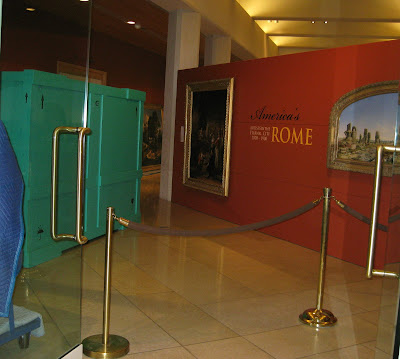 What a month it's been in Curatorial! After nearly two years of planning, more than 100 paintings have arrived on our doorstep to be uncrated and installed in time for Saturday's opening of America's Rome: Artists in the Eternal City, 1800-1900. The pieces look spectacular, especially when placed in their appropriate groupings and hung on the wall. The exhibition will take you through the Roman Forum, the Colosseum, and particularly the Campagna, or countryside. There are great Hudson River School style paintings by Thomas Cole, Albert Bierstadt, George Inness, Jasper Cropsey, and Sanford R. Gifford, among others. All of these painters traveled to Rome to improve their art, and the results showed in the fame they received upon returning and painting American landscapes in the same style. Come see for your self. The public opening is this Saturday, May 23, beginning at 10 am.

 Exhibit panels have been printed and final preparations are well underway for the upcoming exhibition at the


